

Newsroom
Looking for something specific? Search through our press releases by keyword:
Find Releases by Date
- July 2026
- June 2026
- May 2026
- April 2026
- March 2026
- February 2026
- January 2026
- December 2025
- November 2025
- October 2025
- September 2025
- August 2025
- July 2025
- June 2025
- May 2025
- April 2025
- March 2025
- February 2025
- January 2025
- December 2024
- November 2024
- October 2024
- September 2024
- August 2024
- July 2024
- June 2024
- May 2024
- April 2024
- March 2024
- February 2024
- January 2024
- December 2023
- November 2023
- October 2023
- September 2023
- August 2023
- July 2023
- June 2023
- May 2023
- April 2023
- March 2023
- February 2023
- January 2023
- December 2022
- November 2022
- October 2022
- September 2022
- August 2022
- July 2022
- June 2022
- May 2022
- April 2022
- March 2022
- February 2022
- January 2022
- December 2021
- October 2021
- September 2021
- August 2021
- July 2021
- June 2021
- May 2021
- April 2021
- March 2021
- February 2021
- January 2021
- December 2020
- November 2020
- September 2020
- July 2020
- June 2020
- May 2020
- April 2020
- March 2020
- February 2020
- January 2020
- December 2019
- November 2019
- October 2019
- September 2019
- July 2019
- June 2019
- May 2019
- April 2019
- March 2019
- February 2019
- January 2019
- December 2018
- November 2018
- October 2018
- September 2018
- August 2018
- January 2018
- November 2017
- August 2017
Senate Committee Unanimously Approves Bill to Support Vulnerable Kids Through Child Abuse Cases
Senate Committee Unanimously Approves Bill to Support Vulnerable Kids Through Child Abuse Cases
DENVER, CO – Today, legislation sponsored by Senator Lisa Cutter, D-Jefferson County, to help children who are navigating child abuse cases in the justice system unanimously passed the Senate Judiciary Committee.
“Kids who have experienced unthinkable trauma deserve justice, but in the process of getting it, they’re often forced to re-live their experiences in court proceedings and have limited resources while navigating a complicated system,” Cutter said. “This legislation would give them trauma-informed resources so they have the information and support they need to get that justice from their abusers.”
HB26-1103 would require law enforcement agencies to report child sex offense claims to a local child advocacy center (CAC) within a week of when the alleged offense occurred. If there is no CAC within the judicial district, the agency must report the alleged offense to the CAC that they determine would best serve the child.
Current law allows a child under 12 years old to give testimony in a room other than the courtroom if the judge believes that the child would experience serious emotional distress or trauma in the presence of the defendant. The bill would raise the age to under 18 years old, require courts to make considerations about a child’s ability to give testimony in front of the alleged offender, and allow for collaboration with a child advocacy center to conduct interviews.
There are 19 CACs across Colorado with over 33,000 child abuse professionals and community members who provide wraparound services to survivors. Each CAC has trained forensic interviewers and victim advocates to support the child through the judicial process and with mental health services.
The legislature is concurrently considering the Colorado Child Advocacy Center Act, which would reinforce the expectations that CACs coordinate with law enforcement and adopt trauma-informed practices as they move through the investigation, treatment, and prosecution processes.
HB26-1103 now moves to the Senate floor for further consideration. Track its progress here.
Committee Advances Bill to Strengthen Victim Compensation
DENVER, CO – The Senate Judiciary Committee today passed legislation to prioritize direct victims of crime over insurance companies in restitution payments.
HB26-1017, sponsored by Senator Mike Weissman, D-Aurora, would clarify Colorado law regarding insurance companies’ eligibility for restitution.
“Restitution should be reserved for victims of crime so they can get their life back on track – not to further pad the pockets of insurance companies,” said Weissman. “Insurance companies that have paid out claims following a crime are not victims, they are financial institutions designed to balance risk and loss. This bill would create clarity and consistency for restitution decisions going forward.”
Restitution is court-ordered payment from a convicted offender to the victim, designed to cover financial losses directly resulting from a crime. Under current law, insurers of a victim of a crime can receive restitution payments in criminal cases. HB26-1017 would prohibit insurance companies from receiving these restitution payments unless they are a direct victim of a crime such as fraud, theft, or property damage.
The bill would clarify Colorado’s laws on insurance companies’ eligibility for restitution that have been the subject of confusion in Colorado courts.
HB26-1017 now heads to the Senate floor for further consideration. Track its progress HERE.
Senate Unanimously Approves Bill to Support Survivors of Crimes
SB26-095 would update Colorado law to improve transparency, strengthen survivor rights, and bolster trauma-informed procedures in court and law enforcement response
DENVER, CO – Legislation sponsored by Senator Mike Weissman, D-Aurora, to improve access to care for survivors of crime and strengthen trauma-informed justice practices unanimously passed the Senate today.
“Under current Colorado law, survivors of crime face significant barriers to care, justice, and information about their proceedings,” Weissman said. “I am proud to sponsor this long-overdue legislation to improve access to care, ensure trauma-informed justice procedures and law enforcement response, and strengthen protections for the rights of survivors in court proceedings.”
SB26-095 would make several updates to Colorado statute, including:
Ensuring that victims are informed of how to obtain results and other records related to forensic testing;
Creating a special motion to dismiss claims arising from protected survivor statements made during investigations or legal proceedings, helping to shield survivors from retaliatory lawsuits;
Limiting the enforceability of mandatory pre-dispute arbitration and joint-action waivers, thereby strengthening the rights of survivors in sexual misconduct disputes;
Authorizing remote forensic testimony and allowing certain survivors to voluntarily testify remotely; and
Expanding training and use of peace officer training funds to include trauma-informed law enforcement response training.
SB26-095 now moves to the House for further consideration. Track its progress here.
Legislation to Improve Training and Response for Missing College Students Passes Committee Unanimously
SB26-120 would create uniform procedures for the critical hours after a college student goes missing
DENVER, CO – Bipartisan legislation to improve response time, coordination, and training for when a college student goes missing unanimously passed the Senate Judiciary Committee today.
SB26-120, sponsored by Senators Janice Marchman, D-Loveland, and Katie Wallace, D-Longmont, would require peace officers seeking or renewing their Peace Officer Standards and Training (POST) certification to undergo missing person alerts training. It would also create new, standardized protocols for higher education institutions to minimize delays and ensure best practices when a student goes missing.
“I brought forward this bill in partnership with the brave families who have lived through the unthinkable – their child going missing, on or off a Colorado college campus,” said Marchman. “This bipartisan bill ensures that our peace officers are trained to properly use the full range of missing persons alert systems. It also creates a clear, consistent process for colleges and universities to respond quickly, protect students, and ensure families get the answers they need.”
“When a loved one goes missing, every minute matters, and any delay or confusion is unacceptable,” said Wallace. “Under current law, college students can and have fallen through the cracks. This bill creates clear protocols for colleges and universities when a student is reported missing and ensures officers are trained to act with urgency and precision during those critical first hours.”
Under the bill, the required training for peace officers during POST certification and recertification would include training on Amber Alerts, Silver Alerts, Blue Alerts, and the State Emergency Alert System.
SB26-120 would also require that when a student is reported missing, a higher education institution may conduct a structured internal search for up to six hours. This would include digital contact, a residential check, inquiry to available faculty and staff, and emergency contact outreach. Institutions must document this process, retain records for three years, and publish this policy publicly. If a student is not found within six hours, or if there is credible evidence of risk, the institution must immediately notify campus police or the nearest law enforcement agency, if the institution does not have its own police department.
SB26-120 now heads to the Senate floor for further consideration. Track its progress HERE.
Senate Committee Advances HOME Act to Build More Housing Now
HB26-1001 would make it easier for non-profits, schools, and transit districts to build affordable housing on their land
DENVER, CO – Today, the Senate Local Government and Housing Committee approved the Housing Opportunities Made Easier (HOME) Act, sponsored by Senators Tony Exum, Sr., D-Colorado Springs, and Julie Gonzales, D-Denver, which would streamline the process for many non-profits, schools, and transit districts to build affordable housing on their land.
“Too many families in Colorado Springs are afraid of being priced out of the place they call home,” Exum said. “If we’re serious about solving the housing crisis in Colorado, we need to open up every available option to get our neighbors secure and affordable housing. The HOME Act would help our communities build the housing that is so desperately needed in our state.”
“Access to affordable and secure housing is the reason I am able to serve my community at all,” Gonzales said. “We have a housing crisis in this state, and Coloradans who work multiple jobs to make ends meet still can’t afford to buy a home and plant roots in their communities. This bill would allow community organizations more flexibility to give their neighbors that gift of stable, affordable housing.”
Beginning December 31, 2027, HB26-1001 would streamline the process for building housing by allowing non-profit organizations, housing authorities, school districts, state colleges, Board of Cooperative Educational Services, universities, and transit districts to build on their land. It would unlock centrally-located and underutilized land to build housing near job centers, transit hubs, schools, and local businesses. These residential developments could also include child care centers and facilities that provide recreational, social, or educational services to residents.
Under the HOME Act, local governments could not reject the construction of a residential development due to height, as long as the development adheres to the height standards of the zoning district or is no taller than three stories or 38 feet. Additionally, local governments may require notification to residents and accept public comments on administrative projects, ensuring that community feedback can be heard.
HB26-1001 applies to land up to five acres. Exemptions to this bill would include land that is not connected to water and sewage treatment systems, land where state or federal regulations restrict residential housing, properties zoned for industrial or agricultural use, floodplains, open space, and municipalities that have already implemented similar process standards.
In 2022, Colorado voters approved Proposition 123 to create and fund new housing affordability programs for low- and middle-income Coloradans. This bill would provide an additional incentive to build affordable housing by counting each unit of affordable housing built on these qualifying properties as 1.1 units, boosting eligibility for Proposition 123 funding.
A 2022 report found that removing bureaucratic barriers in the permitting process can expedite the approval process by 28-percent.
HB26-1001 now moves to the Senate floor for further consideration. Track its progress here.
Committee Unanimously Approves Bill to Support Survivors of Crimes
SB26-095 would update Colorado law to improve transparency, strengthen survivor rights, and bolster trauma-informed procedures in court and law enforcement response
DENVER, CO – Legislation sponsored by Senator Mike Weissman, D-Aurora, to improve access to care for survivors of crime and strengthen trauma-informed justice practices unanimously passed the Senate Judiciary Committee today.
“Under current Colorado law, survivors of crime face significant barriers to care, justice, and information about their proceedings,” Weissman said. “I am proud to sponsor this long-overdue legislation to improve access to care, ensure trauma-informed justice procedures and law enforcement response, and strengthen protections for the rights of survivors in court proceedings.”
SB26-095 would make several updates to Colorado statute, including:
Ensuring that victims are informed of how to obtain results and other records related to forensic testing;
Creating a special motion to dismiss claims arising from protected survivor statements made during investigations or legal proceedings, helping to shield survivors from retaliatory lawsuits;
Limiting the enforceability of mandatory pre-dispute arbitration and joint-action waivers, thereby strengthening the rights of survivors in sexual misconduct disputes;
Authorizing remote forensic testimony and allowing certain survivors to voluntarily testify remotely; and
Expanding training and use of peace officer training funds to include trauma-informed law enforcement response training.
SB26-095 now moves to the Senate floor for further consideration. Track its progress here.
Legislation to Support First Responders Through Affordable Housing Opportunities Clears Senate
DENVER, CO – Today the Senate approved Senator Kyle Mullica’s, D-Thornton, bipartisan legislation to support first responders and help them afford to live in the communities where they serve.
SB26-053, cosponsored by Senator Barbara Kirkmeyer, R-Weld County, would expand eligibility for mortgage loans through the Colorado Housing and Finance Authority (CHFA) to include peace officers, firefighters, emergency medical technicians, correctional officers, 911 operators, and their families who qualify as low- or moderate-income.
“This bill is about taking care of those who take care of us,” said Mullica. “By expanding eligibility for Colorado Housing and Finance Authority’s mortgage loans to first responders, we can help ensure that the folks who protect our communities can actually afford to live in the communities where they serve. When we have an opportunity to take care of our first responders, we should jump at that opportunity.”
The bill would implement an income cap of 110 percent of the CHFA cap on other programs. CHFA’s home mortgage program offers access to fixed-rate mortgage loans for low- and moderate-income Coloradans. They also provide homeowner education and down payment assistance to support working families as they live, work, and thrive in their communities.
SB26-053 now moves to the House for further consideration. Track its progress here.
Senate Democratic Leadership Welcomes Senator Adrienne Benavidez to Colorado Senate
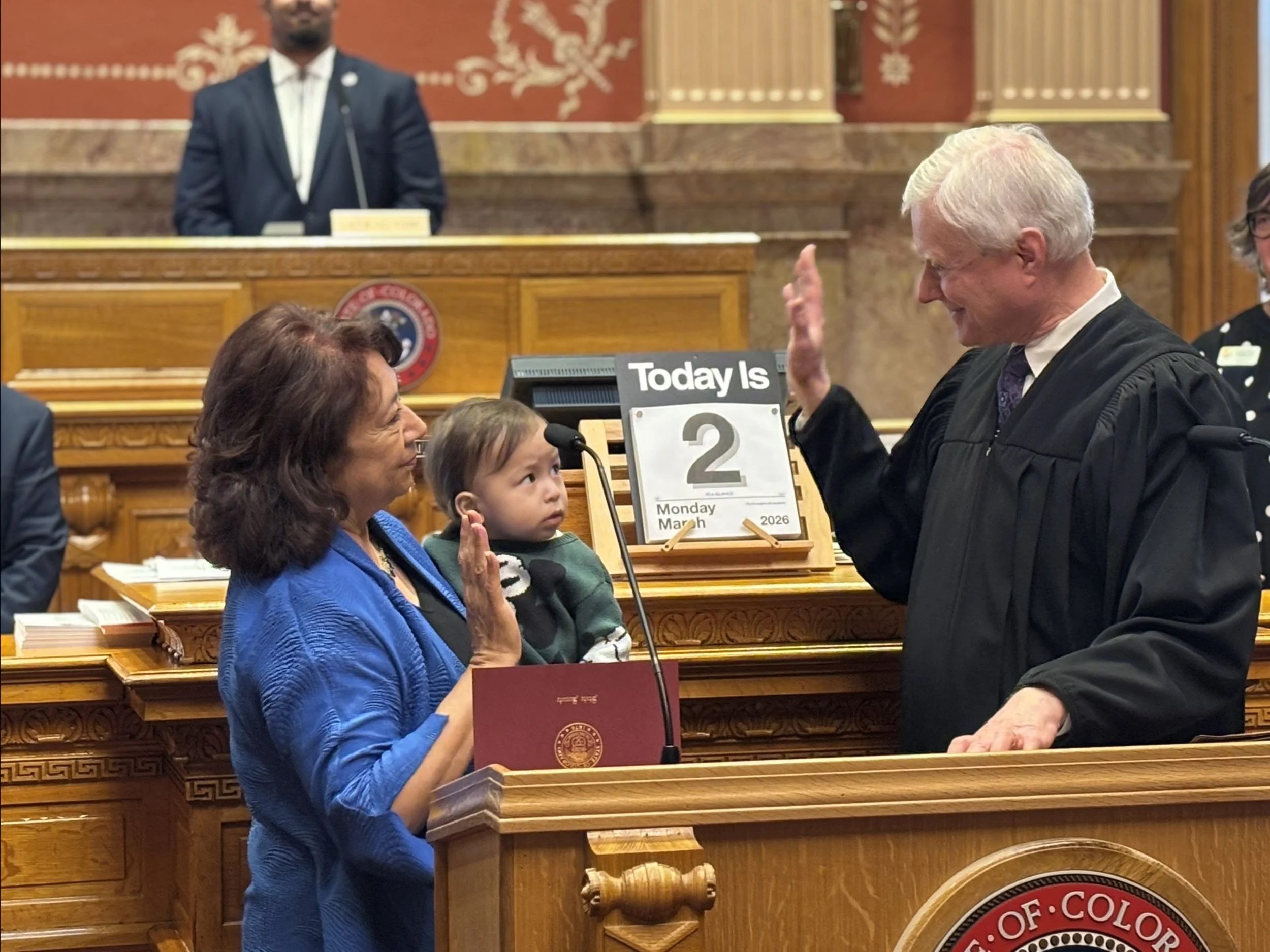
DENVER, CO – Following her official swearing in by Judge Lino S. Lipinsky de Orlov, Senate President James Coleman, D-Denver, and Senate Majority Leader Robert Rodriguez, D-Denver, today welcomed Senator Adrienne Benavidez, D-Commerce City, to the Colorado Senate.
“On behalf of the Senate Democratic Caucus, I want to extend a warm welcome to Senator Benavidez,” said Coleman. “We’re mid-way through an ambitious legislative session where we are working on lowering costs for Colorado families, creating opportunities through education and workforce development, and standing up for what’s right amid federal tumult. I have the utmost confidence that Senator Benavidez will be a champion for this important work.”
“Senator Benavidez has always brought a discerning eye to every bill, committee hearing, and debate she’s been a part of, and our work in the legislature is stronger because of it,” said Rodriguez. “With her officially on board, we’re ready to hit the ground running and continue this session’s impactful work.”
“I’m humbled and honored to be selected to represent the people of Senate District 21,” said Benavidez. “I am committed to fighting for reproductive freedom, supporting small businesses and Colorado workers, standing up to the Trump Administration, and protecting the rights of our immigrant communities. The hardworking people of my district deserve representation that will advocate for their needs and concerns. I hope to make them proud!”
Senator Adrienne Benavidez represents Senate District 21, Adams and Arapahoe Counties. Benavidez formerly represented House District 32 and served on the House Finance, Judiciary Committee, and State, Veterans, and Military Affairs Committees. Prior to her time in office, Benavidez worked as an attorney, was the executive director of the Denver Department of General Services, and directed the Colorado Division of Finance and Procurement.
Legislation to Create More Affordable Home Ownership Opportunities Passes Committee
SB26-040 would modernize the Prop 123 Affordable Homeownership Program to better meet families’ needs
DENVER, CO – Bipartisan legislation to update the Affordable Homeownership Program created by voter-approved Proposition 123 passed the Senate Local Government and Housing Committee today.
SB26-040, sponsored by Senator Judy Amabile, D-Boulder, would expand eligibility for qualified buyers and make practical updates to better serve every Colorado community and meet the reality of the 2026 housing market.
“The Affordable Homeownership Program was designed in 2022, for a 2022 market with low interest rates and lower construction costs than what we see today,” said Amabile. “This bill updates the program to reflect today’s reality and provide the flexibility that Coloradans need. We’re taking a practical approach to make sure this program works as intended so more Colorado families can put down roots and achieve their dream of homeownership.”
The bill, also sponsored by Senate Minority Leader Cleave Simpson, R-Alamosa, would increase the allowable income threshold to qualify for the program to less than or equal to 120 percent of statewide Area Median Income (AMI) or the local AMI. This would allow more people to qualify for the program, particularly in rural communities.
Rising interest rates and insurance costs have also made it harder for Coloradans to meet the requirement that combined housing costs cannot exceed 35 percent of their income. This bill would create a process to allow some homeowners to spend more than 35 percent of their income on housing when a qualified buyer is not found after six months of advertising.
Additionally, the bill would allow eligible organizations to temporarily rent units if they cannot be sold in a timely manner and create more flexibility in the program rules. These updates would help ensure that the program is working as intended and serving as many Coloradans as possible.
SB26-040 now heads to the Senate floor for further consideration. Track its progress HERE.
Legislation to Help Colorado Families Achieve Economic Mobility Clears Committee
SB26-080 would establish a grant program to support community-based Cradle-to-Career initiatives
DENVER, CO – Today, the Senate Local Government and Housing Committee approved legislation sponsored by Senate President James Coleman, D-Denver, to create a Cradle-to-Career grant program supporting locally-led initiatives that offer education and workforce development training.
“Cycles of generational poverty persist because, starting from birth, too many Coloradans are not afforded the resources they need to succeed,” Coleman said. “This new grant program would offer those resources to invest directly in communities, support housing and economic stability for Colorado families, and strengthen our state’s workforce by preparing young people for high-demand, family-sustaining careers.”
SB26-080, cosponsored by Senate Minority Leader Cleave Simpson, R-Alamosa, would create a Cradle-to-Career grant program within the Colorado Department of Human Services to fund community-based efforts that improve economic mobility from prenatal stages through workforce readiness. Eligible applicants include local governments, education providers including higher education institutions, tribes and tribal organizations, and nonprofit organizations.
Program approvals will be overseen by an advisory board and will be funded by Harlem Children’s Zone, a national nonprofit specializing in Cradle-to-Career initiatives. Approved grants would support programs advancing goals like K-12 readiness and academic proficiency, enrollment in skills training and credential attainment, and employment at a good wage.
SB26-080 now moves to the Senate Appropriations Committee for further consideration. Track its progress here.
Bill to Promote EV Battery Recycling Clears Committee
SB26-003 would improve responsible electric vehicle battery recycling, disposal, and storage
DENVER, CO – Legislation to promote responsible recycling, reusing, and managing of electric vehicle (EV) batteries at the end of a vehicle’s life passed the Senate Transportation and Energy Committee today.
SB26-003, sponsored by Senator Katie Wallace, D-Longmont, and Assistant Majority Leader Lisa Cutter, D-Jefferson County, would improve end-of-life management for EV batteries.
“Coloradans who drive electric vehicles care about reducing their environmental footprint,” said Wallace. “But right now, Colorado lacks a clear framework to specify who is responsible for the battery at the end of a vehicle’s life, and that means batteries that could be re-used or recycled are needlessly going to waste. I’m proud to sponsor this legislation to promote the reuse of EV batteries and keep Colorado moving toward a more sustainable future.”
“Colorado is a leader in electric vehicle adoption. It's important that EV batteries are handled properly to ensure they are not a fire hazard, and ultimately recycled effectively," said Cutter. "This bill will help reduce reliance on newly mined minerals and improve the sustainability of electric vehicles. I have worked on sustainability, clean energy, and the circular economy for several years, so it's exciting to be part of this next big step for Colorado.”
The bill would require EV manufacturers to collect and responsibly handle unwanted batteries, promoting the reuse and/or repurposing of viable batteries and ensuring responsible end-of-life management. Manufacturers would also be required to submit regular safety plans on EV battery management to the Colorado Department of Public Health and Environment Hazardous Waste Division. Additionally, SB26-003 would put in place new environmental and safety guidelines and minimum mineral recovery rates for battery recycling, ensuring the use of best practices, reducing environmental impact from mining and smelting, and supporting Colorado’s manufacturing economy.
Efficient recycling techniques reduce the environmental impact of electric vehicles and can help meet the demand for lithium, cobalt, and nickel for new EV batteries.
SB26-003 now heads to the Senate Appropriations Committee for further consideration.
Senate Approves Bill to Protect the Dignity of Minors
DENVER, CO – Today, the Senate approved legislation sponsored by Senators Katie Wallace, D-Longmont, and Chris Kolker, D-Centennial, to protect the dignity of minors by suppressing court records of petitioned name changes for petitioners under 18.
"Minors change their names for many reasons including religious or cultural naming ceremonies, family changes like adoption, and gender transition. Because these court records are currently public, minors who have legal name changes can be easily identified, putting them at risk,” Wallace said. “This bill is about protecting these young people, and ensuring their privacy and dignity. Sen. Kolker and I thank the diligent and thoughtful advocates who mended fragments in the LGBTQ coalition to shed light on an issue impacting children from a wide variety of marginalized identities."
“Many of the parents in my district have expressed how much it matters to support, protect, and celebrate their child’s identities during their most formative years,” Kolker said. “I’m proud to sponsor this legislation to give kids and their families the power to protect their privacy.”
SB26-018 would require a court to automatically suppress records associated with name change petitions for petitioners under 18, unless the petitioner was previously convicted of a felony. These suppressed records can be accessed without a court order if they receive verbal consent from the petitioner to unseal those records.
A 2024 study showed that 47 percent of trans and nonbinary young people in Colorado considered suicide in the past year. The use of a chosen name for transgender youth can improve mental health outcomes, and acceptance of trans and nonbinary youth’s gender identity has been shown to decrease suicide attempts.
SB26-018 now moves to the House for further consideration. Track its progress HERE.
Bill to Safeguard Constitutional Rights Passes Senate
SB26-005 would create legal remedies in state court for an individual harmed during a civil immigration enforcement action where constitutional rights were violated
DENVER, CO – Today, the Senate approved legislation to strengthen constitutional protections by ensuring that those harmed by unconstitutional conduct by federal immigration enforcement officials have a pathway to justice in state court.
SB26-005, sponsored by Senators Mike Weissman, D-Aurora, and Julie Gonzales, D-Denver, would create a state law cause of action for violations of the United States Constitution that occur in the context of federal civil immigration enforcement.
“People have long come to our country for the promise of a better life and the guarantee of equal treatment under the law,” said Weissman. “I’m proud to sponsor legislation to protect our constitutional rights and create legal remedies when those rights are violated. Senate Bill 5 stands for the basic principles that government agents must follow the law like everyone else and that there should be legal remedies when constitutional rights are violated. This legislation reaffirms the civil rights of all Coloradans.”
“Under the Trump Administration, we are witnessing the conflation of immigration status, dissent, and criminality,” said Gonzales. “Our government is telling us not to believe what we see with our own eyes. It is up to us to act boldly and bravely, create pathways of real accountability for those who violate our fundamental rights and freedoms, and ensure everyone is treated with dignity and respect in Colorado.”
This bill would allow Coloradans to pursue legal action against federal officers if their rights under the U.S. Constitution are violated during a civil immigration enforcement action. Those found responsible for such violations could be held liable to the injured party for appropriate legal or equitable relief.
SB26-005 now moves to the House for further consideration. Track its progress HERE.
Committee Approves Bill to Safeguard Coloradans’ Privacy
SB26-070 aims to better protect Coloradans’ personal data collected by Automated License Plate Reader technology
DENVER, CO – Today, the Senate Judiciary Committee passed legislation sponsored by Senator Judy Amabile, D-Boulder, aimed at protecting Coloradans’ personal data collected by Automated License Plate Readers (ALPRs) from being indiscriminately shared and retained.
“New technologies can serve as useful tools for law enforcement, and our goal is not to limit their use to keep Coloradans safe,” Amabile said. “However, keeping Coloradans safe also means ensuring their privacy is not being invaded, that their data is secure and not used by ICE or against people seeking reproductive health care. This bill will provide clear rules for law enforcement, safeguard privacy, and strengthen public trust without compromising public safety.”
SB26-070, cosponsored by Senator Lynda Zamora Wilson, R-El Paso County, would establish a framework that preserves law enforcement’s ability to protect public safety while ensuring that access to historical location information collected by ALPRs complies with the Fourth Amendment.
To establish these standards, the bill would:
Require law enforcement to attain a valid warrant to access historical location information, except for limited exceptions like emergency situations where a warrant is deemed impractical;
Prevent data sharing with out-of-state agencies, except under clearly defined circumstances or court order;
Prohibit the sale of historical location data;
Mandate the creation of a detailed data access record as well as routine audits and public reports;
Limit the length of time historical information may be retained to 30 days, unless a warrant or active investigation justifies longer retention; and
Authorize the Attorney General to seek injunctive relief for intentional violations.
ALPR technologies, like Flock cameras, have raised concerns in recent years, and their use in immigration enforcement operations has sparked outrage in Denver and cities across Colorado. Flock currently operates in 75 communities in Colorado.
SB26-070 now moves to the Senate Appropriations Committee for further consideration. Track its progress HERE.
Senate Democrats Elect Senator Cathy Kipp To Serve as President Pro Tempore
DENVER, CO –Senate Democrats today elected Senator Cathy Kipp, D-Fort Collins, to serve as President Pro Tempore.
“I send a heartfelt congratulations to Senator Cathy Kipp for her election as Senate President Pro Tempore,” said Senate President Coleman, D-Denver. “In leadership, our role is to govern the chamber effectively and fairly, build relationships, and serve with good conscience and a strong moral compass. I’m supremely confident in the leadership of Senator Kipp and look forward to working closely together to deliver for the people of Colorado.”
“I’m honored to be selected by my colleagues in the Senate to serve as President Pro Tempore,” said Kipp. “In recent years, our caucus has passed legislation to improve the lives of Coloradans, and, this year, we continue our commitment to putting working families first. I look forward to serving the caucus in a new position to be an extra set of eyes and ears, fill in for the President when necessary, and ensure that everyone – legislators, staff, visitors, and constituents – is treated with dignity and respect.”
The Pro Tempore position was left vacant by the resignation of Senator Dafna Michaelson Jenet, D-Commerce City. Senator Kipp will hold this position for the remainder of the 75th General Assembly.
Senate Advances FY25-26 Supplemental Budget Package on Preliminary Vote
Supplemental package implements cuts necessitated by H.R. 1
DENVER, CO – The Senate today advanced the FY 2025-2026 supplemental budget package on a preliminary vote. The bills, HB26-1150 through HB26-1179, are sponsored by Joint Budget Committee (JBC) members including Vice Chair Jeff Bridges, D-Arapahoe County, and Judy Amabile, D-Boulder. The package will be heard on third reading in the Senate tomorrow.
“Today’s supplemental budget cuts come in response to Trump’s Big Whatever Bill, which caused a massive reduction in revenue resulting in cuts to Medicaid, higher education, and housing,” said Bridges. “Today’s bills take a responsible approach to the difficult task of balancing our budget, preserving core services while making hard choices caused by Trump’s cuts and TABOR’s cap.”
“H.R. 1 funded tax cuts for the wealthy at the expense of working families, and now it’s up to us to re-balance our budget,” said Amabile. “Though painful, the cuts in this package put Colorado on a more sustainable path to preserve funding for core priorities in future years while protecting funding for Medicaid eligibility. I remain focused on mitigating harm, protecting the critical services that Colorado families rely on, and finding solutions to responsibly manage our budget.”
In July 2025, Congressional Republicans passed H.R. 1, which gave tax breaks to wealthy individuals and corporations. Because Colorado’s tax code mirrors the federal tax code, the cuts in H.R. 1 impacted state revenue by roughly $1.2 billion for the 2025-26 fiscal year. During August’s special session, Colorado Democrats spearheaded a responsible plan to close corporate tax loopholes, authorize the Governor to reduce some spending, and modestly dip into Colorado’s reserves to put our budget back in balance.
This supplemental budget package implements spending reductions proposed by Governor Jared Polis to balance the 2025-2026 budget. As a result, the supplemental package contains significant reductions as compared to a typical year, totaling approximately $140 million in general fund cuts across state departments, even as Medicaid utilization and caseload costs grew by approximately $220 million from the general fund.
Legislation to Protect Children Online, Improve Public Safety Passes Senate
SB26-011 would ensure timely, reliable compliance with search warrants
DENVER, CO – Bipartisan legislation to protect children online and improve public safety passed the Senate today.
SB26-011, sponsored by Senator Dylan Roberts, D-Frisco, would establish precise requirements for how large online social media platforms must receive, acknowledge, and respond to search warrants issued by Colorado courts.
“As a former Deputy District Attorney, I saw firsthand how critical digital evidence can be in serious criminal investigations,” said Roberts. “Increasingly, warrants are being disregarded or not treated with the seriousness they deserve by social media platforms, and delays in accessing evidence can have real consequences. SB26-011 helps ensure that court-approved warrants are respected so investigators can move quickly and responsibly.”
Also sponsored by Senator Lisa Frizell, R-Castle Rock, the bill would cover social media websites, online services, or mobile applications that have at least one million monthly users, allow users to create profiles, and allow users to create or share content.
Under the bill, covered platforms must have a clear process for communication with law enforcement, provide a staffed hotline available to law enforcement 24/7, acknowledge receipt of a search warrant within eight hours and comply within 72 hours in most cases, provide status updates on warrant compliance, and prominently post contact information for search warrant compliance on their homepage. The bill would be enforced by the Attorney General or local district attorneys.
SB26-011 now moves to the House for further consideration. Track its progress HERE.
JOINT RELEASE: Colorado Democrats to Create Tax Code that Puts Hardworking Coloradans First
Four bills would close corporate tax loopholes to lower taxes for hardworking people
DENVER, CO - Colorado Democrats today unveiled four new bills to rebalance Colorado’s tax code and put working people first after Congress passed H.R. 1, which granted massive tax breaks to corporations and the ultra-wealthy that cut off tax relief for families. The bills would create a new tax credit, modeled after the highly successful Family Affordability Tax Credit, to boost the incomes of hardworking Colorado families.
In recent years, Democrats in Colorado have expanded the state Earned Income Tax Credit (EITC) and Child Tax Credit (CTC) and created the Family Affordability Tax Credit (FATC) to boost the incomes of hardworking Colorado families and lift children out of poverty. A 2026 report found that the EITC, CTC and FATC cut child poverty by 37-percent and family poverty by 32-percent. These tax credits were turned off for the next two tax years due to H.R. 1.
“We have a choice– we can give taxpayer-funded handouts to mega-corporations and the Jeff Bezos’ of the world or we can update Colorado’s tax code to benefit the hardworking people of our state,” said Rep. Lorena García, D-Unincorporated Adams County. “When the federal GOP passed H.R. 1 last year, most of the tax breaks went to corporations and the ultra-wealthy. This eliminated Colorado’s state tax breaks for working people, which have slashed child poverty by nearly 40-percent. Colorado Democrats are now closing special interest corporate tax breaks and handouts to boost the incomes of hardworking Coloradans.”
“Colorado’s tax code should work for the people of Colorado, not provide special treatment for monied interests that aren’t effective in advancing state goals,” said Senator Mike Weissman, D-Aurora. “Recent tax and other law changes at the federal level have been devastating. We must use this moment as an opportunity to examine our tax code and re-balance the scales toward working people. Cleaning up our tax code is a critical way we can mitigate the harms taking place in Washington and put Coloradans first.”
Beginning for 2026 taxes, the three bills that will be introduced today would create a new Family Affordability Credit that could be taken in addition to the CTC, EITC and FATC. The credit is revenue neutral – it will adjust based on available revenue, so that families receive all the benefits from modernizing the tax code.
Three bills that will be introduced today will create the new credit. The first bill prioritizes working families and ensures corporations and high-earners pay their fair share by closing tax loopholes that offer deductions for top executives’ salaries. A second bill mitigates the harm of H.R. 1 and would decouple Colorado’s tax code from four new federal tax deductions to rein in these corporate tax breaks, especially for out-of-state investments. A third bill would tax software the same, regardless of how it is acquired.
Additionally, a fourth bill will be introduced in the coming days and would modernize and simplify the tax code by repealing ineffective or unnecessary special tax exemptions and deductions to expand and extend tax credits for wildfire and beetle kill mitigation, job creators, and investments in clean energy.
Prioritizing Working Families, Reps. Yara Zokaie and Emily Sirota, Sens. Judy Amabile and Katie Wallace: This bill would close a tax loophole that allows corporations to deduct the salaries of their CEO, CFO and the next eight highest-paid executives—up to $1 million each—as ‘operating expenses,’ even if the executive doesn’t reside in Colorado.
“We’re closing tax loopholes for the ultra-wealthy and corporations so we can create a more fair tax code that puts money back into the pockets of hardworking Coloradans and lifts families out of poverty,” said Rep. Yara Zokaie, D-Fort Collins. “When people are struggling to juggle their rent, groceries and utility bills, Trump’s corporate tax breaks for million-dollar salaries are a slap in the face for hardworking Coloradans. With this bill, Colorado Democrats are cracking down on taxpayer funded corporate giveaways to restore the balance toward middle and lower income people.”
“Tax credits for working families and children are a lifeline, and they’re at risk because of the chaos from Washington,” said Senator Judy Amabile, D-Boulder. “H.R. 1 devastated our ability to fund tax credits that lift families out of poverty and give Colorado kids a chance to succeed. This bill is about setting Colorado’s tax code on Colorado’s terms, closing corporate tax loopholes, and putting everyday Coloradans first.”
“Colorado is at a crossroads– we can build an economy where everyone has a fair shot or we can protect tax breaks for CEO salaries and loopholes that allow the very wealthy to avoid paying their fair share,” said Rep. Emily Sirota, D-Denver. “The tax credits we created are helping families put food on the table, but if we don’t pass these bills, the largest corporations and wealthiest individuals will see their taxes cut while families pay more. This legislation is one of many steps that Colorado Democrats are taking to rebalance Colorado’s tax code toward working people so we can drive down child poverty and put more money back into families’ pockets.”
“Just because the federal government sold out working families for huge corporate tax breaks, it doesn’t mean Colorado should do the same,” said Senator Katie Wallace, D-Longmont. “This legislation closes tax loopholes to balance the scales back toward everyday Coloradans and ensure that corporations pay their fair share in our state. By doing so, we can mitigate the harms caused by H.R. 1 and uplift more of Colorado’s working families.”
The Alternative Minimum Tax (AMT) requires some high-income earners to pay a minimum amount of tax, regardless of how many deductions they are eligible for, but there is a state tax credit that reduces what they are required to pay under the AMT. The bill would repeal this credit, which only exists in three states. The bill would also lower the percentage of net operating loss deductions that corporations can deduct from their Colorado taxable income and shorten the length of time that they can carry those losses forward before claiming them, a technique that corporations use to avoid paying taxes year after year, even while making significant profits.
Mitigating the Harm of H.R. 1, Reps. Lorena García and Karen McCormick and Sen. Cathy Kipp: This bill would de-couple Colorado’s tax code from four business tax breaks created or expanded by H.R. 1, including certain write-offs and deductions for interest expenses on debt, especially for multi-national corporations.
“Colorado Democrats are focused on building an economy that rewards hardworking people in Colorado, which is why we’re limiting corporate tax breaks so we can lower taxes for middle and lower income people,” said Rep. Karen McCormick, D-Longmont. “H.R. 1 has already had devastating impacts on our state, and Colorado Democrats are taking every step we can to undo the harm and put working families first. Our legislation would end corporate handouts paid for by Colorado taxpayers, especially for out-of-state investments, so that our tax code rewards hardworking people and uplifts families, not the largest corporations.”
“The Federal H.R. 1 – the big, bad billionaires bill – included tax deductions for corporations that were automatically placed into our state tax code, whether or not they benefit Colorado businesses and workers,” said Senator Cathy Kipp, D-Fort Collins. “The changes proposed in this bill keep Colorado from spending our tax dollars on development outside of Colorado, instead putting those benefits toward the well-being of families and children in our communities.”
Updating and Simplifying the Tax Code, Reps. Lorena García and Kyle Brown and Sen. Weissman: This bill, which will be introduced in the coming days, would repeal ineffective or unnecessary tax exemptions and deductions and modify others to make Colorado’s tax code more consistent and efficient.
“We’re updating Colorado’s tax code to prioritize hardworking Coloradans, create jobs and reduce costs,” said Rep. Kyle Brown, D-Louisville. “H.R. 1 rigged Colorado’s tax code in favor of corporations and the 1%, leaving us to pick up the pieces to lessen the blow on hardworking Coloradans. With this bill, we’re leaving no stone unturned by closing tax loopholes and eliminating ineffective tax breaks to extend and expand tax credits for small businesses, wildfire mitigation and renewable energy that create jobs, boost incomes and save people money.”
The bill would repeal ineffective tax exemptions for metal bullion, coins and purchases regarding space flight. It would also eliminate vendor discounts for cigarettes, nicotine and tobacco products.
It also makes changes to existing tax credits, including:
Increasing access to the Community Food Access Tax Credit that offers small food retailers and family farms a refundable tax credit;
Renewing the Renewable Energy Enterprise Zone Investment Tax Credit to reward businesses that invest in projects that generate renewable energy; and
Expanding the Wildfire Mitigation Tax Credit by making it a refundable tax credit and increasing eligibility to boost wildfire mitigation efforts.
Expanding a tax credit for businesses that rehabilitate vacant properties.
Downloadable Software, Rep. Steven Woodrow, Speaker Pro Tempore Andy Boesenecker and Sen. Matt Ball: This bill would repeal the downloadable software exemption to ensure taxes on these products are consistent, no matter how or where they are purchased.
“We’re creating a more equitable tax code for Coloradans,” said Rep. Steven Woodrow, D-Denver. “This tax exemption on downloadable software has been inconsistently applied, so we’re bringing this legislation to prevent Coloradans from being taxed differently due to the way the product is being delivered. Our legislation equally applies sales tax across the board to modernize Colorado’s tax code and prioritize tax relief for working people.”
“After Congress changed our tax code to favor the wealthy, we’re stepping in to support working families with a new Family Affordability Credit,” said Senator Matt Ball, D-Denver. “This legislation will also modernize our tax code to treat downloadable software the same as software you’d purchase in store, which will enable us to put money back into the hands of families who need it.”
“Our bill would ensure sales tax on software isn’t being applied arbitrarily,” said Speaker Pro Tempore Andy Boesenecker, D-Fort Collins. “Whether someone purchases Microsoft Word online or in person, they should not be taxed differently. This bill would ensure that Coloradans could expect to pay the same taxes, no matter what zip code or manner in which they purchase software.”
The Colorado Office of the State Auditor reported that the antiquated sales tax exemption for certain downloadable software was being applied unevenly across the state, with 14-percent of vendors not applying the exemption at all.
JOINT RELEASE: Bill to Make it Easier for Consumers to End Automatic Contract Renewals Fully Goes Into Effect
SB25-145 requires sellers to offer simple online cancellation of automatic renewal contracts or trial periods
DENVER, CO – Legislation to protect consumers from burdensome automatic renewal contract cancellations fully goes into effect Monday, February 16, 2026.
Sponsored by Senator Cathy Kipp, D-Fort Collins, and Representatives Mandy Lindsay, D-Aurora, and Yara Zokaie, D-Fort Collins, SB25-145 requires sellers of goods and services to implement simple mechanisms for consumers to cancel automatic renewal contracts and trial periods either online or in-person. Failure to do so constitutes a deceptive trade practice under the Colorado Consumer Protection Act.
“There is nothing more frustrating than signing up for a free trial or a subscription only to have to jump through hoop after difficult hoop to try to cancel that subscription,” said Kipp. “This new law helps prevent deceptive practices and simplifies the process for Coloradans to cancel their subscriptions online, saving them time and money in the long run.”
“While companies make it simple to start a subscription online, they often add extra steps to cancel, and we do not think that is fair for Colorado consumers,” said Lindsay. “Our new law is going into effect, requiring businesses to make the cancellation process straightforward for consumers. This will save Coloradans time cancelling unwanted subscriptions and money on services or products they don’t need.”
“Too many companies are using complicated cancellation processes to trap consumers into contracts with costly charges. We passed a law last year to simplify the cancellation process for Coloradans,” said Zokaie. “From Netflix and Amazon Prime to gym memberships, subscription services are prevalent in our daily lives. Our new law requires the option to cancel online, saving Coloradans money on services they no longer find useful.”
SB25-145 builds upon HB21-1239, also sponsored by Kipp, which provided transparency to consumers entering into automatic renewal contracts, to further shore up consumer protections.
Legislation to Protect Children Online, Improve Public Safety Passes Committee Unanimously
SB26-011 would ensure timely, reliable compliance with search warrants
DENVER, CO – Bipartisan legislation to protect children online and improve public safety passed the Senate Judiciary Committee unanimously today.
SB26-011, sponsored by Senator Dylan Roberts, D-Frisco, would establish precise requirements for how large online social media platforms must receive, acknowledge, and respond to search warrants issued by Colorado courts.
“As a former Deputy District Attorney, I saw firsthand how critical digital evidence can be in serious criminal investigations,” said Roberts. “Increasingly, warrants are being disregarded or not treated with the seriousness they deserve by social media platforms, and delays in accessing evidence can have real consequences. SB26-011 helps ensure that court-approved warrants are respected so investigators can move quickly and responsibly.”
Also sponsored by Senator Lisa Frizell, R-Castle Rock, the bill would cover social media websites, online services, or mobile applications that have at least one million monthly users, allow users to create profiles, and allow users to create or share content.
Under the bill, covered platforms must have a clear process for communication with law enforcement, provide a staffed hotline available to law enforcement 24/7, acknowledge receipt of a search warrant within eight hours and comply within 72 hours in most cases, provide status updates on warrant compliance, and prominently post contact information for search warrant compliance on their homepage. The bill would be enforced by the Attorney General or local district attorneys.
SB26-011 now moves to the Senate floor for further consideration. Track its progress HERE.