

Newsroom
Looking for something specific? Search through our press releases by keyword:
Find Releases by Date
- July 2026
- June 2026
- May 2026
- April 2026
- March 2026
- February 2026
- January 2026
- December 2025
- November 2025
- October 2025
- September 2025
- August 2025
- July 2025
- June 2025
- May 2025
- April 2025
- March 2025
- February 2025
- January 2025
- December 2024
- November 2024
- October 2024
- September 2024
- August 2024
- July 2024
- June 2024
- May 2024
- April 2024
- March 2024
- February 2024
- January 2024
- December 2023
- November 2023
- October 2023
- September 2023
- August 2023
- July 2023
- June 2023
- May 2023
- April 2023
- March 2023
- February 2023
- January 2023
- December 2022
- November 2022
- October 2022
- September 2022
- August 2022
- July 2022
- June 2022
- May 2022
- April 2022
- March 2022
- February 2022
- January 2022
- December 2021
- October 2021
- September 2021
- August 2021
- July 2021
- June 2021
- May 2021
- April 2021
- March 2021
- February 2021
- January 2021
- December 2020
- November 2020
- September 2020
- July 2020
- June 2020
- May 2020
- April 2020
- March 2020
- February 2020
- January 2020
- December 2019
- November 2019
- October 2019
- September 2019
- July 2019
- June 2019
- May 2019
- April 2019
- March 2019
- February 2019
- January 2019
- December 2018
- November 2018
- October 2018
- September 2018
- August 2018
- January 2018
- November 2017
- August 2017
FROM THE OFFICE OF SENATOR DAFNA MICHAELSON JENET: Senate President Pro Tem Dafna Michaelson Jenet Releases Statement
DENVER, CO – Senate President Pro Tempore Dafna Michaelson Jenet, D-Commerce City, issued a statement today following the submission of her letter of resignation from the Colorado Senate:
“Today it is with gratitude and a heavy heart that I announce my resignation from the Colorado Senate. Serving the people of Senate District 21, and previously House District 32, has been the honor of a lifetime, and I reflect on more than nine years of public service with immense pride.
Each and every day, I pushed hard to make the most of the brief time we have to shape Colorado’s future. From creating the I Matter program to connect every Colorado child with mental health support, to guaranteeing free and healthy school meals for all, I have fought hard to ensure every Colorado kid has the resources and opportunities they need to thrive. This work, and more, has saved lives and helped result in Colorado’s lowest youth suicide rate since 2007.
I have also been a proud representative and leader within Colorado’s Jewish community, using my position to share and celebrate our identity, history, and faith. Part of this work culminated in legislation guaranteeing Holocaust studies are incorporated into Colorado's public school curriculum.
I always aspire to serve with joy, humility, and guided by the will of my constituents. I am so thankful to the people of Senate District 21 for their trust, to my colleagues in the House and Senate for their partnership on legislation both big and small, and to my family for their perseverance and grace at every step of this journey.
As my tenure at the Capitol comes to a close, I am excited and hopeful about the opportunities ahead as I step up to serve as Director of the David Merage Foundation for Confronting Antisemitism."
Senate Approves Legislation to Protect Colorado Nonprofits from Federal Threats
SB26-009 would allow Colorado nonprofits who have had their federal tax-exempt status revoked for political reasons to maintain their exemption from state sales tax
DENVER, CO – The Senate today approved legislation to protect Colorado nonprofits from hostile federal actions.
SB26-009, sponsored by Senators Marc Snyder, D-Manitou Springs, and William Lindstedt, D-Broomfield, would ensure that nonprofit organizations that have lost their federal tax-exempt status for politically motivated reasons remain exempt from state sales tax.
“Nonprofit organizations in our state are cornerstones of their communities, supporting countless Coloradans through difficult times,” Snyder said. “Chaos in the federal government threatens to upend these organizations’ ability to serve their communities. This bill would offer much-needed stability and dependability to charitable groups across our state.”
“Political retribution from the federal government could throw essential nonprofit organizations and the Colorado families who rely on them into chaos and financial distress,” Lindstedt said. “This legislation would fulfill our state’s responsibility to offer stability to valid charitable organizations amidst federal turbulence.”
SB26-009 would ensure that valid 501(c)(3) organizations maintain their state tax exemption, even if the federal government removes their federal tax-exempt status for political reasons. It would also ensure that the state maintains its authority to deny tax exemption for organizations that have lost their federal nonprofit status for legitimate reasons.
Over the past year, Colorado nonprofits have increasingly struggled to navigate frenzied federal actions that call into question their budgetary futures and ability to serve their communities. SB26-009 is another in a host of actions Colorado Democrats have taken to protect Coloradans’ way of life amid federal threats.
SB26-009 now moves to the House for further consideration. Track its progress HERE.
Bipartisan Pair of Roberts Bills to Support Rural and Mountain Communities Passes Committee
DENVER, CO – Today, a pair of bipartisan bills sponsored by Senator Dylan Roberts, D-Frisco, to support rural and mountain communities passed out of the Senate Agriculture and Natural Resources Committee.
“Coal workers deserve the opportunity to transition to good-paying jobs in the communities where they live and want to be for years to come,” said Roberts. “For years, they’ve provided for their families and powered our communities, and they should have the chance to benefit from new technologies, industries and opportunities coming to Northwest Colorado and beyond. SB64 also supports our mountain and rural communities by expanding eligibility for agricultural loans and strengthening water conservation efforts. These bipartisan bills that passed committee today reflect my commitment to the workers and farmers who are the backbone of Colorado’s rural and mountain economies.”
SB26-052, also sponsored by Senator Marc Catlin, R-Montrose, would require certain businesses in a coal transition community to give hiring preference to former coal workers who meet the job requirements. Covered businesses would include railroads, utilities, energy generation, and advanced manufacturing. The covered businesses would report annually to the Colorado Office of Just Transition on positions filled by coal transition workers and recruitment efforts by the business.
The committee also approved SB26-064. Also sponsored by Minority Leader Cleave Simpson, R-Alamosa, the bill would expand eligible recipients for the Agriculture Future Loan Program, allowing the Colorado Department of Agriculture (CDA) to provide loans to state-certified water conservation entities.
Initially created in 2021 by the legislature, the Agricultural Future Loan Program provides low-interest loans and grants to newer or underrepresented producers who lack access to traditional capital to help them grow their farms, ranches, and agribusinesses.
Senate Approves Bill to Safeguard Science-Backed Vaccine Recommendations
SB26-032 would protect consistent, science-backed state vaccine guidance
DENVER, CO –Today, the Senate approved legislation to protect Coloradans’ access to immunizations and science-backed decision making, regardless of changes to federal guidance.
SB26-032, sponsored by Senators Lindsey Daugherty, D-Arvada, and Kyle Mullica, D-Thornton, would allow Colorado to continue to rely on science-backed vaccine guidelines from health professional organizations in addition to federal guidance, and would add protections to ensure consistent vaccine access and coverage.
“As an ER nurse, I know that protecting Coloradans’ access to immunizations is a matter of life and death,” said Mullica. “Vaccines must continue to be widely available and given according to a schedule based on science and evidence. With this bill, we’re standing up to protect Coloradans’ health and safety and insulating Colorado from the dysfunction in Washington.”
“Vaccines are medical miracles,” said Daugherty. “Adults, children, and infants used to die every day from diseases that we have all but eradicated because of immunizations. It is crucial that, regardless of the confusion spreading from RFK and the White House, Coloradans have access to evidence-based care and the vaccines that keep us and our children healthy.”
The bill would also codify pharmacists’ authority to prescribe and administer vaccines and expand existing state liability protections to all health care providers and entities who provide immunizations.
Colorado law has traditionally relied on federal vaccine recommendations. Recent shifts in federal vaccine guidance have created uncertainty and confusion, and more states are turning to trusted professional organizations for guidance. The trusted health organizations named in SB26-032 are the American Academy of Pediatrics, the American Academy of Family Physicians, the American College of Physicians, and the American College of Obstetricians and Gynecologists.
The legislation would build upon last year’s SB25-196, sponsored by Mullica and Senator Iman Jodeh, D-Aurora, which protected insurance coverage for preventive care including vaccines and HB25-1027, also sponsored by Mullica and Daugherty, which directed the state Board of Health to take into consideration the recommendations of these professional organizations in immunization requirements. The bill would not create new vaccine mandates and would not change medical and non-medical exemptions under Colorado law.
SB26-032 now moves to the House for further consideration. Track its progress HERE.
Bill to Unlock Local Governments’ Ability to Address Housing Needs Passes Senate
SB26-001 would make funds available for workforce and affordable housing
DENVER, CO – Today, the Senate approved bipartisan legislation to give local governments additional flexibility to address housing shortages.
SB26-001, sponsored by Senators Dylan Roberts, D-Frisco, and Jeff Bridges, D-Arapahoe County, would allow counties to use existing resources to support workforce and affordable housing, removing outdated restrictions that limit their ability to respond to local housing needs.
“I’m proud that the first bill introduced in the Senate this year is one to unlock local governments’ ability to meet their own housing needs,” said Roberts. “This bill will cut red tape and give counties, municipalities, and housing authorities more tools to help them build and maintain housing for more working families and individuals. This means more opportunities for Coloradans to stay in their communities and stable housing for the workers who keep our rural and mountain towns running.”
“Local governments know their housing needs, and the state shouldn't artificially limit the tools they can use to ensure their residents have a place they can afford to live,” said Bridges. “This bill removes barriers for counties and municipalities to invest in affordable and workforce housing and accelerates development. It’s a common-sense approach that gets out of the way and lets local communities address housing shortages.”
The bill would also allow local governments to sell, lease, or acquire property for the purpose of workforce or affordable housing and create a tax exemption for construction materials used for workforce housing projects. Additionally, SB26-001 would update Colorado’s Middle-Income Housing Tax Credit to help projects secure financing by allowing the credits to be transferred to individuals, firms, or corporations that do not own a project interest.
SB26-001 now moves to the House for further consideration. Track its progress HERE.
Legislation to Protect Colorado Nonprofits from Federal Threats Passes Senate Committee
SB26-009 would allow Colorado nonprofits who have had their federal tax-exempt status revoked for political reasons to maintain their exemption from state sales tax
DENVER, CO – The Senate Finance Committee today unanimously approved legislation to protect Colorado nonprofits from hostile federal actions.
SB26-009, sponsored by Senators Marc Snyder, D-Manitou Springs, and William Lindstedt, D-Broomfield, would ensure that nonprofit organizations that have lost their federal tax-exempt status for politically motivated reasons remain exempt from state sales tax.
“Nonprofit organizations in our state are cornerstones of their communities, supporting countless Coloradans through difficult times,” Snyder said. “Chaos in the federal government threatens to upend these organizations’ ability to serve their communities. This bill would offer much-needed stability and dependability to charitable groups across our state.”
“Political retribution from the federal government could throw essential nonprofit organizations and the Colorado families who rely on them into chaos and financial distress,” Lindstedt said. “This legislation would fulfill our state’s responsibility to offer stability to valid charitable organizations amidst federal turbulence.”
SB26-009 would ensure that valid 501(c)(3) organizations maintain their state tax exemption, even if the federal government removes their federal tax-exempt status for political reasons. It would also ensure that the state maintains its authority to deny tax exemption for organizations that have lost their federal nonprofit status for legitimate reasons.
Over the past year, Colorado nonprofits have increasingly struggled to navigate frenzied federal actions that call into question their budgetary futures and ability to serve their communities. SB26-009 is another in a host of actions Colorado Democrats have taken to protect Coloradans’ way of life amid federal threats.
SB26-009 now moves to the Senate floor for further consideration. Track its progress HERE.
Senate Approves Bill to Expand and Improve Colorado’s Red Flag Law
SB25-004 would build on past legislation to prevent gun violence and save lives
DENVER, CO – Today, the Senate approved legislation to expand Colorado’s existing “Red Flag” law to proactively de-escalate violent situations and save lives.
SB26-004, sponsored by Senators Tom Sullivan, D-Centennial, and Julie Gonzales, D-Denver, would expand the list of community members eligible to petition for an Extreme Risk Protection Order (ERPO) to include health care and education institutions.
“In Colorado, our ‘Red Flag’ law has already helped prevent gun violence, but we can strengthen it to give more people the opportunity to save lives,” said Sullivan. “Adding health care and education facilities to the list of qualified petitioners for an ERPO helps ensure that trusted community members are able to reach those who are a danger to themselves or others sooner and stop more violence before it occurs.”
“Colorado’s ‘Red Flag’ law exists to prevent gun violence so that families have the freedom to go to school, church, and the grocery store without fear,” said Gonzales. “Strengthening this already highly effective law will allow us to stop preventable acts of gun violence and save more Coloradans' lives.”
SB26-004 would add health care facilities that employ co-responders and health care professionals to the list of community entities that may petition the court for an extreme risk protection order (ERPO). It would also add health care facilities, behavioral health treatment facilities, K-12 schools, and higher education institutions as institutional petitioners that may petition a court for an ERPO.
Passed in 2019, Colorado Democrats’ original ERPO legislation allows qualified individuals to petition a judge to temporarily remove a firearm from a potentially dangerous individual and interrupt gun violence before it has a chance to occur. In 2023, lawmakers passed legislation to expand the list of qualified individuals eligible to petition for an ERPO to include DAs and other law enforcement officials, licensed health care professionals, educators, and mental health professionals.
In 2024, the most recent data available, there were 164 ERPO petitions filed in Colorado.
SB26-004 now moves to the House for further consideration. Track its progress here.
Bill to Safeguard Constitutional Rights Passes Committee
SB26-005 would create legal remedies in state court for an individual harmed during a civil immigration enforcement action where constitutional rights were violated
DENVER, CO – Today, the Senate Judiciary Committee approved legislation to strengthen constitutional protections by ensuring that those harmed by unconstitutional conduct by federal immigration enforcement officials have a pathway to justice in state court.
SB26-005, sponsored by Senators Mike Weissman, D-Aurora, and Julie Gonzales, D-Denver, would create a state law cause of action for violations of the United States Constitution that occur in the context of federal civil immigration enforcement.
“People have long come to our country for the promise of a better life and the guarantee of equal treatment under the law,” said Weissman. “I’m proud to sponsor legislation to protect our constitutional rights and create legal remedies when those rights are violated. Senate Bill 5 stands for the basic principles that government agents must follow the law like everyone else and that there should be legal remedies when constitutional rights are violated. This legislation reaffirms the civil rights of all Coloradans.”
“Under the Trump Administration, we are witnessing the conflation of immigration status, dissent, and criminality,” said Gonzales. “Our government is telling us not to believe what we see with our own eyes. It is up to us to act boldly and bravely, create pathways of real accountability for those who violate our fundamental rights and freedoms, and ensure everyone is treated with dignity and respect in Colorado.”
This bill would allow Coloradans to pursue legal action against federal officers if their rights under the U.S. Constitution are violated during a civil immigration enforcement action. Those found responsible for such violations could be held liable to the injured party for appropriate legal or equitable relief.
The legislation aims to protect Coloradans’ constitutional rights amid intensifying violence by federal immigration officials, including the fatal shootings of U.S. citizens Renee Good and Alex Pretti at the hands of federal immigration officers in Minneapolis.
SB26-005 now moves to the Senate Appropriations Committee for further consideration. Track its progress HERE.
JOINT RELEASE: Colorado Democrats To Safeguard Constitutional Rights
DENVER, CO – Colorado Democrats today unveiled a new legislative package to safeguard Coloradans’ constitutional rights, support immigrant communities and build trust in public services.
Two new bills will be introduced in the Colorado House of Representatives in the coming weeks and SB26-005 will be heard in the Colorado Senate Judiciary Committee this afternoon. SJR26-006, the Immigrants’ Rights Resolution, was heard on the Colorado Senate floor this morning and passed on a party-line vote of 20 to 12.
“Federal law enforcement is engaging in dangerous, unlawful immigration enforcement tactics that are perpetuating fear in our communities and, in some cases, even death. Enough is enough,” said Rep. Lorena García, D-Unincorporated Adams County, sponsor of forthcoming legislation to strengthen protections. “Across the country, U.S. citizens are being detained and children are being used as bait to lure parents into detention centers, all while federal law enforcement completely disregards our constitutional rights. In Colorado, we’ll defend and uphold your constitutional rights with new legislation aimed at shoring up privacy protections and law enforcement transparency.”
“People have long come to our country for the promise of a better life and the guarantee of equal treatment under the law,” said Sen. Mike Weissman, D-Aurora, sponsor of SB26-005, SJR26-006, and forthcoming legislation to strengthen protections. “I’m proud to sponsor legislation to protect our constitutional rights, create legal remedies when those rights are violated, and publicly affirm our commitment to Colorado’s immigrant communities. In particular, Senate Bill 5 stands for the basic principles that government agents must follow the law like everyone else and that there should be legal remedies when constitutional rights are violated. This legislation reaffirms the civil rights of all Coloradans.”
Last year, Democratic lawmakers passed SB25-276 to strengthen existing data privacy protections and clarify constitutional protections for immigrants. Forthcoming legislation sponsored by Representatives Velasco and García and Senators Jodeh and Weissman would build upon legislative efforts by:
Increasing accountability and transparency by enforcing violations when personal information is shared unlawfully and informing individuals whose information has been shared with federal officials;
Requiring reporting on demographic populations in immigration detention centers and regular environmental and health inspections of centers;
Establishing protections from deportation when an individual is in transit to or from a health care facility, school, child care center, court or place of worship.
“Over the past few months, ICE activity has left many Coloradans living in fear,” said Sen. Iman Jodeh, D-Aurora, sponsor of SJR26-006 and forthcoming legislation to strengthen protections. “Our entire community is harmed when fear replaces trust. As legislators, we have a responsibility to make sure that Coloradans of all backgrounds feel safe. This legislation is about leading with compassion, protecting our constitutional rights, and ensuring Colorado is a place where every family can live with dignity and safety.”
“Immigrants and U.S. citizens who look like me are being met with violence from federal law enforcement, and they’re skipping work, school and medical appointments because they’re afraid of being detained,” said Rep. Elizabeth Velasco, D-Glenwood Springs, sponsor of forthcoming legislation to strengthen protections. “In Colorado, we won’t stand idly by while the federal government disregards our constitutional rights. Soon, we’re unveiling new legislation to strengthen protections and push back against the egregious federal overreach we’re witnessing across the country.”
“Under the Trump Administration, we are witnessing the conflation of immigration status, dissent, and criminality,” said Sen. Julie Gonzales, D-Denver, sponsor of SB26-005. “Our government is telling us not to believe what we see with our own eyes. It is up to us to act boldly and bravely, create pathways of real accountability for those who violate our fundamental rights and freedoms, and ensure everyone is treated with dignity and respect in Colorado.”
“We are a nation of immigrants, and at a moment when fear and division are being weaponized, Colorado must stand firmly for civil liberties and human dignity, " said Rep. Javier Mabrey, D-Denver, sponsor of SB26-005. "When federal immigration agents violate someone’s Fourth Amendment rights, as we've witnessed in Minnesota, there must be accountability. The Constitution applies to everyone in Colorado, and this bill creates a clear cause of action so that no agency, no matter how powerful, is above the law."
SB26-005, sponsored by Senators Weissman and Gonzales and Representatives Mabrey and Zokaie, would uphold constitutional rights by allowing Coloradans harmed during an immigration enforcement encounter with federal officers to pursue legal action against them. SB26-005 establishes a state court cause of action for damages arising from violations of the U.S. Constitution, and those found responsible for such violations could be held liable.
“What we’re witnessing across America at the hands of federal agents is a blatant disregard for our rights,” said Rep. Yara Zokaie, D-Fort Collins, sponsor of SB26-005 and forthcoming legislation to encourage government accountability and help build public trust in law enforcement. “Children as young as five years old are being detained and separated from their families, and the inhumane tactics of federal law enforcement are causing serious harm, injury, and in some cases even death. In Colorado, we will safeguard our rights and work in partnership with law enforcement to ensure accountability. We must stand now to protect our communities from the erosion of civil liberties levied by the federal government.
“Alex Pretti and Renee Good were U.S. citizens killed by federal law enforcement while engaging in constitutionally protected activity,” said Rep. Meg Froelich, D-Englewood, sponsor of forthcoming legislation to encourage government accountability and help build public trust in law enforcement. “We should not have to weigh our lives to protest our government in the United States of America. Law enforcement works for the people, and new legislation we’re carrying this session will help foster stronger public trust in those who swore an oath to protect us.”
Forthcoming legislation, sponsored by Representatives Froelich and Zokaie and Senators Jodeh and Weissman, would encourage government accountability and help build public trust in law enforcement. Under the bill, any law enforcement officer working on behalf of local, state, and federal law enforcement agencies must wear identification and would be prohibited from covering their face. This includes the agency name or initials and their identification number on the outermost layer of clothing. If law enforcement officers refuse or fail to properly identify themselves, they could be held liable for impersonating a peace officer. The bill also requires law enforcement to receive training on Colorado’s immigration laws to ensure they enforce state laws properly.
“America was founded on the shared beliefs of freedom and fairness, and that must never be taken for granted,” said Rep. Junie Joseph, D-Boulder, sponsor of SJR26-006. “As federal agents attack peaceful protesters, unlawfully detain U.S. citizens and deport people without due process, we must stand now to defend our constitutional rights.”
“The harsh enforcement tactics of federal agents put local law enforcement and our community members exercising their constitutional rights at risk,” said Rep. Naquetta Ricks, D-Aurora, sponsor of SJR26-006. “This resolution calls on our federal government to uphold our civil rights and constitutional protections.”
The Immigrants' Rights Resolution, sponsored by Senator Jodeh and Weissman and Representatives Joseph and Ricks, calls on the federal government to reaffirm its obligation to uphold civil rights and constitutional protections. The resolution demands the federal government reaffirm civil rights for all, end anonymous enforcement tactics, and protect access to education, health care, and civic participation. SJR26-006 advocates for modernized, humane federal immigration reform and supports state-level measures that safeguard constitutional rights.
Bill to Safeguard Science-Backed Vaccine Recommendations Passes Committee
SB26-032 would protect consistent, science-backed state vaccine guidance
DENVER, CO – Today, the Senate Health and Human Services Committee approved legislation to protect Coloradans’ access to immunizations and science-backed decision making, regardless of changes to federal guidance.
SB26-032, sponsored by Senators Lindsey Daugherty, D-Arvada, and Kyle Mullica, D-Thornton, would allow Colorado to continue to rely on science-backed vaccine guidelines from health professional organizations in addition to federal guidance, and would add protections to ensure consistent vaccine access and coverage.
“As an ER nurse, I know that protecting Coloradans’ access to immunizations is a matter of life and death,” said Mullica. “Vaccines must continue to be widely available and given according to a schedule based on science and evidence. With this bill, we’re standing up to protect Coloradans’ health and safety and insulating Colorado from the dysfunction in Washington.”
“Vaccines are medical miracles,” said Daugherty. “Adults, children, and infants used to die every day from diseases that we have all but eradicated because of immunizations. It is crucial that, regardless of the confusion spreading from RFK and the White House, Coloradans have access to evidence-based care and the vaccines that keep us and our children healthy.”
The bill would also codify pharmacists’ authority to prescribe and administer vaccines and expand existing state liability protections to all health care providers and entities who provide immunizations.
Colorado law has traditionally relied on federal vaccine recommendations. Recent shifts in federal vaccine guidance have created uncertainty and confusion, and more states are turning to trusted professional organizations for guidance. The trusted health organizations named in SB26-032 are the American Academy of Pediatrics, the American Academy of Family Physicians, the American College of Physicians, and the American College of Obstetricians and Gynecologists.
The legislation would build upon last year’s SB25-196, sponsored by Mullica and Senator Iman Jodeh, D-Aurora, which protected insurance coverage for preventive care including vaccines and HB25-1027, also sponsored by Mullica and Daugherty, which directed the state Board of Health to take into consideration the recommendations of these professional organizations in immunization requirements. The bill would not create new vaccine mandates and would not change medical and non-medical exemptions under Colorado law.
SB26-032 now moves to the Senate floor for further consideration. Track its progress HERE.
Bill to Unlock Local Governments’ Ability to Address Housing Needs Passes Committee
SB26-001 would make funds available for workforce and affordable housing
DENVER, CO – Today, the Senate Local Government and Housing Committee approved bipartisan legislation to give local governments additional flexibility to address housing shortages.
SB26-001, sponsored by Senators Dylan Roberts, D-Frisco, and Jeff Bridges, D-Arapahoe County, would allow counties to use existing resources to support workforce and affordable housing, removing outdated restrictions that limit their ability to respond to local housing needs.
“I’m proud that the first bill introduced in the Senate this year is one to unlock local governments’ ability to meet their own housing needs,” said Roberts. “This bill will cut red tape and give counties, municipalities, and housing authorities more tools to help them build and maintain housing for more working families and individuals. This means more opportunities for Coloradans to stay in their communities and stable housing for the workers who keep our rural and mountain towns running.”
“Local governments know their housing needs, and the state shouldn't artificially limit the tools they can use to ensure their residents have a place they can afford to live,” said Bridges. “This bill removes barriers for counties and municipalities to invest in affordable and workforce housing and accelerates development. It’s a commonsense approach that gets out of the way and lets local communities address housing shortages.”
The bill would also allow local governments to sell, lease, or acquire property for the purpose of workforce or affordable housing and create a tax exemption for construction materials used for workforce housing projects. Additionally, SB26-001 would update Colorado’s Middle-Income Housing Tax Credit to help projects secure financing by allowing the credits to be transferred to individuals, firms, or corporations that do not own a project interest.
SB26-001 now moves to the Senate floor for further consideration. Track its progress HERE.
Bill to Expand and Improve Colorado’s Red Flag Law Passes Senate Committee
SB25-004 would build on past legislation to prevent gun violence and save lives
DENVER, CO – Today, the Senate State, Veterans, & Military Affairs Committee approved legislation to expand Colorado’s existing “Red Flag” law to proactively de-escalate violent situations and save lives.
SB26-004, sponsored by Senator Tom Sullivan, D-Centennial, would expand the list of community members eligible to petition for an Extreme Risk Protection Order (ERPO) to include health care and education institutions.
“In Colorado, our ‘Red Flag’ law has already helped prevent gun violence, but we can strengthen it to give more people the opportunity to save lives,” said Sullivan. “Adding health care and education facilities to the list of qualified petitioners for an ERPO helps ensure that trusted community members are able to reach those who are a danger to themselves or others sooner and stop more violence before it occurs.”
SB26-004 would add health care facilities that employ co-responders and health care professionals to the list of community entities that may petition the court for an extreme risk protection order (ERPO). It would also add health care facilities, behavioral health treatment facilities, K-12 schools, and higher education institutions as institutional petitioners that may petition a court for an ERPO.
Passed in 2019, Colorado Democrats’ original ERPO legislation allows qualified individuals to petition a judge to temporarily remove a firearm from a potentially dangerous individual and interrupt gun violence before it has a chance to occur. In 2023, lawmakers passed legislation to expand the list of qualified individuals eligible to petition for an ERPO to include DAs and other law enforcement officials, licensed health care professionals, educators, and mental health professionals.
In 2024, the most recent data available, there were 164 ERPO petitions filed in Colorado.
SB26-004 now moves to the Senate floor for further consideration. Track its progress here.
JOINT RELEASE: Colorado Democrats to Lower Costs, Support Small Businesses
DENVER, CO - Colorado Democrats today unveiled three new bills that would make goods and services more affordable for Coloradans and better equip Colorado small businesses to grow and thrive.
A new bill that will be introduced in the coming weeks prohibits corporations from using consumers’ personal data to charge them more or pay them less (surveillance pricing and wage setting).
HB26-1012 cracks down on price gouging where consumers don’t have a choice to shop somewhere else. The bill also requires delivery companies like Instacart and DoorDash to display the in-store price for the goods they are selling so consumers know when they are paying more.
A third bill expected to be introduced in February would prohibit wholesalers from charging small businesses more than large retail corporations for goods.
“The largest corporations are raking in profits by squeezing every last dollar out of consumers, which is why we’re bringing these bills to lower costs, boost small businesses and grow our economy for hardworking people,” said Rep. Javier Mabrey, D-Denver, sponsor of forthcoming legislation to prohibit surveillance pricing. “This package of bills will boost wages, help small businesses to grow and expand, and take on corporate monopolies to encourage a more fair playing field for small businesses. I’m proudly sponsoring legislation that will limit corporations from exploiting personal data to increase corporate profits off the backs of the hardworking people in our state.”
“Coloradans deserve to know they’re paying a fair price and have the opportunity to negotiate for a good wage,” said Sen. Iman Jodeh, D-Aurora, sponsor of forthcoming legislation to prohibit surveillance pricing. “We all lose when large corporations can set different prices for different people based on sensitive data they’ve collected. This bill stands up for workers and families to ensure that your personal data - like where you live and what you’ve bought in the past - is not used against you to raise prices or keep your wages low.”
“Colorado’s economy thrives when everyone has a fair shot, but when big corporations use surveillance data to jack up prices or keep wages low, it hurts our workers and our small businesses,” said Assistant Majority Leader Jennifer Bacon, D-Denver, sponsor of forthcoming legislation to prohibit surveillance pricing. “We’re taking bold steps to make Colorado more affordable, and this legislation stands up for workers, consumers and small businesses by prohibiting the use of your personal data to charge you more or pay you less.”
“Large corporations stack the deck against hardworking Coloradans far more than most of us are aware,” said Sen. Mike Weissman, sponsor of HB26-1012 and forthcoming legislation to prohibit surveillance pricing. “They’re now using artificial intelligence to set prices as high as they think an individual will pay, and wages as low as they think someone will accept. They charge exorbitant prices at places like airports or hospitals where consumers have no other option. Grocery delivery apps charge more than what an item costs in the store without showing the difference. The list goes on. This year, I’m proud to sponsor legislation to tackle these unfair pricing practices, protect consumers, and bring down costs.”
New legislation would prohibit the use of automated decision systems, like AI and other machine-based systems, to strategically set prices based on an individual’s surveillance data, including browsing and purchase history, financial status, habits, and political affiliation. Typically, corporations have weaponized price and wage setting to set prices at the highest amount someone is willing to pay and wages at the lowest amount that someone is willing to accept, based on data that is often collected without an individual’s knowledge or consent. Engaging in these price or wage-setting practices would be considered a deceptive trade practice.
A 2025 Federal Trade Commission report found that individualized pricing tools are being used to target specific consumers with artificially-inflated prices for goods and services based on their surveillance data, such as a person’s location or the motion of a computer mouse.
In 2025, Colorado Democrats passed a law to crack down on ‘junk fees’ to improve price transparency for consumers and bring down costs for Coloradans. HB26-1012 would build on this law by requiring food delivery companies to clearly disclose a comparison between the total price for delivered goods and the total price for those same items if they were purchased in-store instead.
“Corporations know that consumers don’t have a choice but to pay unfair inflated prices, and our legislation says enough is enough,” said Rep. Yara Zokaie, D-Fort Collins, sponsor of HB26-1012. “HB26-1012 would not only limit companies from price gouging ‘captive consumers’, but it would also require food delivery apps to be transparent about in-store pricing so consumers can identify upcharges. This bill builds on efforts to crack down on price gouging and increase price transparency to make Colorado a more affordable place to live.”
“This session, we’re focused on making Colorado more affordable and ensuring our economy works for consumers, workers, and small businesses – not just corporate giants,” said Sen. William Lindstedt, D-Broomfield, sponsor of the forthcoming Unfair Practices Act. “I’m proud to sponsor legislation to increase pricing fairness and help small and mid-size businesses keep up with big retailers by cracking down on backroom deals that box them out of lower wholesale prices. This bill prioritizes fairness, stands up to monopolies and corporate consolidation, and aims to keep costs down for everyone.”
“Colorado Democrats are working to build an economy where small businesses and hardworking people all have a fair shot to thrive,” said Rep. Kyle Brown, D-Louisville, sponsor of HB26-1012 and legislation to crack down on wholesale price discrimination. “Deceptive prices can add up without any real explanation. Our legislation would work to prevent secret price hikes and improve price transparency on these food delivery apps.”
HB26-1012 would also make it a deceptive trade practice to price gouge a “captive consumer,” which is a consumer who does not have realistic alternatives to purchasing a good or service. These situations are often found at airports or at large events, like sports games. HB26-1012 would make it a violation of the Consumer Protection Act to charge these consumers unreasonably excessive prices for that same good or service.
Sponsored by Sens. Lindstedt and Judy Amabile and Rep. Brown, the forthcoming “Unfair Practices Act” would create a more competitive market for Colorado small businesses by preventing wholesalers from charging them more than larger retailers.
“This bill helps independent grocers keep up with mega-corporations like Amazon and Walmart by leveling the playing field when it comes to wholesale deals,” said Sen. Judy Amabile, D-Boulder, sponsor of the forthcoming Unfair Practices Act. “It preserves legitimate price differences based on volume, logistics, or other real cost-savings, but ensures that independent grocers have the same access to discounts as the big guys. As a former small business owner, I know firsthand the impact this can have to bring down costs and help independent grocers stay competitive.”
The bill would establish uniform pricing rules that would require suppliers to offer the same wholesale terms to all retailers that are purchasing under comparable circumstances.
JOINT RELEASE: Gov. Polis and Democratic Lawmakers Introduce Legislation to Reduce Housing Costs
DENVER, CO - Governor Jared Polis and Colorado Democratic lawmakers today unveiled three bills that would drive down housing costs and save Coloradans money.
These bills would streamline the process for many non-profits, schools and transit districts to be part of the housing solution by building housing on their land (HOME Act), fund transit infrastructure improvements and transit-oriented housing (Transit/Housing Investment Zones) and expand tax exemptions to include non-profit housing developers that build affordable rental properties.
“This session, Colorado Democrats are focused on lowering costs, and these three bills will spur more housing now that Coloradans can afford,” said Speaker Julie McCluskie, D-Dillon, sponsor of HB26-1065. “We’re looking to create an innovative funding mechanism for affordable housing near transit hubs, remove barriers to building housing on underutilized land, and encourage more affordable rental housing. These bills will help drive down housing prices, especially in communities like mine in the high country, and bolster Colorado’s transit infrastructure. I’m especially excited that we will be creating housing and transit investment zones that will help local communities finance more housing for every budget.”
“Housing costs are one of the biggest pain points for Coloradans and we are doing everything possible to drive down costs. Everyone deserves to find a home that fits their budget. From the HOME Act, to TIF and lifting up our community land trusts, these efforts will build on our work from years past, and I appreciate the legislators for their work to lead on this important issue,” said Governor Jared Polis.
“We’re taking a big swing at Colorado’s housing shortage to drive down the cost of housing,” said Speaker Pro Tempore Andy Boesenecker, D-Fort Collins, sponsor of HB26-1001. “The HOME Act would remove barriers for public schools, non-profits with a history of building affordable housing, public housing authorities and transit agencies that are willing to build housing on their underutilized land. This bill is one of many that Colorado Democrats are bringing forward this year to save Coloradans money on housing."
“Too many Coloradans are priced out of their homes and communities because of outdated housing restrictions,” said Sen. Julie Gonzales, D-Denver, sponsor of HB26-1001. “The HOME act allows schools, organizations, and local governments to use land that they already own to build the housing our communities need. These groups know what works and should have the freedom to put their land to good use.”
“Colorado Democrats are making it easier to build more housing now to reduce housing costs for Coloradans,” said Rep. Javier Mabrey, D-Denver, sponsor of HB26-1001. “In Denver, we’re already seeing rent rates drop due to an increase in the housing supply. Our bill would give communities throughout Colorado another tool to get affordable housing projects approved and built and deliver more affordable housing.”
Beginning December 31, 2027, HB26-1001 would streamline the process for building affordable housing by allowing non-profit organizations, housing authorities, school districts, state colleges or universities and transit districts to build housing and other community services on their land.
Under the bill, local governments could not reject the construction of a residential development due to height, as long as the development is no taller than three stories or 45 feet or adheres to the height standards of the zoning district. These residential developments could also include childcare centers and facilities that provide recreational, social, or educational services to residents.
A 2022 report found that removing bureaucratic barriers in the permitting process can expedite the approval process by 28-percent.
Lawmakers also unveiled new legislation that will be introduced later today to improve transportation infrastructure, increase transit-oriented housing options that hardworking Coloradans can afford and expand property tax exemptions to include affordable housing non-profits.
"The mountain and rural communities that I represent have some of the most severe affordable housing shortages in the state, and so I’m proud to be sponsoring multiple pieces of legislation this session that will help finance and build housing developments that working families need and can afford,” said Sen. Dylan Roberts, D-Frisco, sponsor of HB26-1065 and SB26-001. “The bills we’re highlighting today will unlock doors for local governments to create new transit infrastructure and housing options, and engage with their communities to invest in innovative housing solutions.”
“Colorado is making great progress on our housing, transit and environmental goals, and this bill combines all of these priorities into one effort to save Coloradans money,” said Rep. Steven Woodrow, D-Denver, sponsor of HB26-1065. “Coloradans want transit options where they actually live. This bill would unlock new tools for communities to harmonize affordable housing and mass transit ridership goals to keep hardworking Coloradans from being priced out of the place they call home.”
“I’m proud to sponsor two bills to tackle the most common concern I hear from my constituents: the cost of housing,” said Sen. Tony Exum, Sr., D-Colorado Springs, sponsor of HB26-1001 and HB26-1065. “By making it possible to build more homes near reliable transit and make better use of underutilized land, we are taking action to address Colorado’s housing shortage. At the end of the day, these bills are about making sure the kids who grow up in Colorado can afford to stay here, that seniors can age in place, and that working families are not forced to leave the communities they love.”
HB26-1065, The Transit Investment Area Act, would create a new financing tool to improve transportation infrastructure and establish a tax credit to build more transit-oriented affordable housing.
The bill would use tax-increment financing to allow local governments to invest state sales tax revenue into transportation infrastructure. Local governments, in partnership with transit agencies, would be able to apply to create a transit and housing investment zone to fund transportation infrastructure projects, like safety improvements and centering transit stops within the community to increase ridership. The bill would allow up to three transit investment projects to be approved in a calendar year, with no more than six projects funded through the bill in total.
HB26-1065 would also create the Colorado Affordable Housing in Transit Investment Zones Tax Credit. This tax credit is reserved for projects that serve low- and middle-income housing within transit and housing zones. The bill would allow up to $50 million in these tax credits per calendar year from 2027 to 2033.
HB26-1066 would expand property tax exemptions for affordable housing developers to include non-profit organizations that build affordable rental properties.
“Colorado Democrats are here to deliver housing options that Coloradans can afford, which is why we’re bringing this bill to create more affordable rental opportunities,” said Rep. Rebekah Stewart, D-Lakewood, sponsor of HB26-1066. “The Community Land Trust and other nonprofit housing developers have been important partners in building more homes that Coloradans can afford, and now it will be easier and less expensive for them to develop properties for rent. Our legislation would provide a tax break to non-profits that build affordable rental properties so we can provide more low-cost housing options to hardworking Coloradans.”
“From my district in the heart of Denver to the furthest corners of our state, Colorado faces a massive crisis in our lack of affordable housing,” said Sen. Matt Ball, D-Denver, sponsor of HB26-1066. “In this environment, every dollar allocated for affordable housing should go to building affordable housing, not paying taxes on vacant land. I’m proud to sponsor this legislation that will reduce cost burdens on everyday Coloradans and the organizations that build necessary affordable housing.”
“This bill would save Colorado renters money by removing barriers to affordable rental housing development,” said Rep. Katie Stewart, D-Durango, sponsor of HB26-1066. “Land is expensive in my corner of Colorado, and it is stifling rental opportunities that hardworking people can actually afford. With our legislation being introduced today, we’re one step closer to opening up more opportunities for Coloradans to afford rental housing, especially in expensive mountain communities on the Western Slope.”
In 2023, Colorado Democrats passed a law to expand property tax exemptions to include more non-profit organizations that build and sell affordable housing. The law also extended the exemption period from 5 to ten years to better reflect the development timeline for larger affordable housing projects. It also created a new property tax exemption for land owned by community land trusts and other non-profit affordable homeownership providers that develop permanently affordable for-sale homes. HB26-1066 would expand this exemption to include affordable rental properties as well as for-sale homes.
Senate Democrats Introduce First Five Bills of 2026 Session
Legislation expands affordable housing, lowers utility bills, encourages environmental stewardship, builds safer communities, and protects civil rights
DENVER, CO – The Colorado Senate Democrats unveiled their First Five Bills of the 2026 legislative session today.
The bills aim to increase affordable housing stock, lower utility bills for low-income Coloradans, boost electric vehicle battery re-use and recycling, build safer communities, and protect Colorado from threats to civil rights.
“We’re excited to kick off the 2026 legislative session focused on lowering costs, boosting public safety, protecting our environment, and meeting the moment to make life better for Coloradans,” said Senate President James Coleman, D-Denver. “We have 120 days to make an impact, and that work starts today.”
“We’re ready to deliver for Coloradans this legislative session,” said Majority Leader Robert Rodriguez, D-Denver. “Over the past few years we’ve worked hard to make Colorado a great place to live, work, and raise a family, but there is more work for us to do. As I begin my final session, I know our caucus is ready to act boldly and lead with courage amid federal threats to our way of life and significant budget constraints. Our First Five Bills of the 2026 legislative session reflect our commitment to lowering costs and protecting Coloradans’ rights and freedoms.”
SB26-001
Senator Dylan Roberts, D-Frisco
Representatives Andrew Boesenecker, D-Fort Collins, & Chris Richardson, R-Elbert County
Currently, counties are prohibited from using general fund property tax revenue to support multi-jurisdictional or statutory housing authorities, like the Eagle County Housing and Development Authority in Senator Roberts’ district. Senate Bill 1 cuts red tape by removing that restriction; providing counties the ability to use property tax revenue to support workforce housing and housing authorities.
SB26-002
Senators Cathy Kipp, D-Fort Collins, Tony Exum, Sr., D-Colorado Springs
Representative Jenny Willford, D-Northglenn
Affordable electricity is increasingly crucial as Colorado transitions to renewable energy. Senate Bill 2 tackles unaffordable utility bills through creation of the FARE (First Allotment of Residential Electricity) service program. For income-qualified customers of an investor-owned utility, the program would provide a minimum level of electricity needed to support basic living needs at a marginal cost rate. The bill also stipulates that implementation of the FARE service must not directly increase the cost of utility services for other customers.
SB26-003
Senators Katie Wallace, D-Longmont, & Lisa Cutter, D-Jefferson County
Representative Kyle Brown, D-Louisville
Colorado is a national leader in electric vehicle (EV) adoption and keeping that momentum is critical to addressing air pollution, as transportation is the leading cause of greenhouse gas emissions in the state. Senate Bill 3 would expand last year's Battery Stewardship Act to include EV batteries and put the Colorado Department of Public Health and Environment Hazardous Waste Division in charge of regulating end-of-life management for electric vehicle batteries. The bill provides the framework for the reuse and repurposing of economically viable batteries via the free market, while ensuring that unwanted batteries are responsibly recycled and not improperly stored or disposed.
SB26-004
Senator Tom Sullivan, D-Centennial
Representative Meg Froelich, D-Englewood
Senate Bill 4 would add health care facilities that employ co-responders and health care professionals to the list of community members that may petition the court for an extreme risk protection order (ERPO). It would also add health care facilities, behavioral health treatment facilities, K-12 schools, and higher education institutions as institutional petitioners that may petition a court for an ERPO.
In 2019, Colorado Democrats passed legislation allowing for the issuance of ERPOs, wherein qualified individuals may petition a judge to temporarily remove a firearm from a potentially dangerous individual and interrupt gun violence before it has a chance to occur. In 2024, the most recent data available, there were 164 ERPO petitions filed in Colorado.
SB26-005
Senators Mike Weissman, D-Aurora, & Julie Gonzales, D-Denver
Representatives Javier Mabrey, D-Denver, & Yara Zokaie, D-Fort Collins
Currently, there is no adequate legal remedy in state or federal court for federal constitutional violations by officials in immigration enforcement. Senate Bill 5 protects constitutional rights by establishing a state court cause of action for damages suffered through violation of the U.S. Constitution in the context of civil immigration enforcement. Under the bill, those found responsible for violations could be held liable for legal or equitable relief, and any claims would have to be filed within two years of the incident.
Senate President James Coleman Delivers Opening Day Remarks
DENVER, CO – Colorado Senate President James Coleman, D-Denver, today delivered his Opening Day Remarks to kick off the 2026 legislative session.
Below is a transcript of Coleman’s remarks as prepared for delivery:
Good morning! Welcome to the second regular session of the 75th General Assembly. It is my honor to be with you all this morning to celebrate the beginning of another legislative session.
I’d like to begin by welcoming our guests this morning. So many family and friends, former lawmakers – basically everyone who doesn’t have to be here when our debates stretch into the night or, God forbid, the weekend.
They aren't here in the chamber today, but I want to acknowledge my family as well. They are my rock, and I would not be here today without them.
Shayna – my wife, and partner of 25 years, thank you for being there to celebrate my successes, for lifting me up on the more challenging days, and for taking on every day together in partnership.
Naomi and James – one of the main reasons I do this work is for you. To help build a future where every door is open and every opportunity is waiting for you. My first opening day, you were both small enough to sit on my lap. Flash forward ten years, you’re behind the wheel of a car. I am so proud of both of you and every day you make me grateful to be your dad.
I would like us all to extend thanks to all our nonpartisan staff, who have seen some changes since we were here this summer for our special session. Join me in welcoming our new members of the Senate team, and members taking on new roles on the team: Olivia Hart, Mary Ann Admire, Matthew Rivera, Benjamin Noren, Dennis Pinto, and Jerry Touslee.
Welcome to the Senate, we’re so happy to have you join the family. And thank you to the returning staff – I’m grateful to work alongside you another year.
If you know me, you know that I don’t do any of this alone. I’d like to thank our Senate leadership team – Majority Leader Rodriguez, President Pro Tempore Michaelson Jenet, Assistant Majority Leader Cutter, Caucus Chair Roberts, and our whip, Senator Hinrichsen – for their help in keeping this train on the tracks.
I also can’t do this without the greatest Minority Leader this chamber has ever seen, Alamosa’s own, Senator Cleave Simpson. It’s an honor to lead alongside you.
We must also give a warm welcome to the newest member of the upper chamber: Senator William Lindstedt! Just wait until you see how efficient we are over here.
I’m just kidding though, of course we love our friends in the House. And I’d be remiss if I didn’t wish the good Speaker McCluskie well in her final session in the House.
Her work to invest in Colorado’s future will be transformative. Whether through implementation of a new school funding formula that ensures resources are going directly to students that need them most, her dedication to protecting Colorado’s water future, and her hand in ensuring access to affordable health care for all – it has been an honor to learn from her and lead alongside her, and I will miss her partnership.
Speaker, don’t forget about us on the other side, and please don’t be a stranger!
And to Governor Polis, who is also entering his final year as the leader of our state. It’s been a privilege to work with you in this leadership capacity and I look forward to all that we’ll accomplish together this year. I can’t wait to hear your final – and I’m sure best – State of the State tomorrow. Last year I learned that my assigned seat is fully in view on the Colorado Channel. I’ve been practicing my facial expressions and reactions all week. I’m ready!
Colleagues, we have been through a lot together over the past year. We have fiercely debated policies with one another, we have deliberated on Colorado’s toughest issues, we have celebrated wins.
And, colleagues, we have grieved together.
We continue to mourn the unexpected, tragic loss of one of our own: Senator Faith Winter.
Faith’s loss is immeasurable, and as we embark on our work this session I hope that we can incorporate her tenacity and the joy that she found in this work into our policies, as well as in the conversations we have with one another.
Because Faith never forgot to be moved by the people behind her policies. She never forgot how to be human in this work – flaws and all.
She would work with anyone who would work with her. A coalition and team builder for the ages, she would not let the letter after someone’s name, a district number, or the county they call home get in the way of getting good policy over the finish line.
Policy that puts Coloradans, and Colorado, first.
We will miss her presence in our chamber each and every day. She showed up with a warmth and brightness reflected in the clothing she wore, the fresh flowers on her desk, and, most of all, in her smile and friendly hello.
May we honor Faith not only in memory, but in how we show up for the work and for one another.
Colleagues, we have accomplished so much together.
In just the last year, we stepped up to protect safety net providers through legislation sponsored by Senators Mullica and Kirkmeyer to ensure Coloradans everywhere from Craig, Cortez, to Crowley are able to receive the health care they need.
We set Colorado kids up for greater prosperity by increasing school funding through last year’s School Finance Act and creation of the Kids Matter Fund, thanks to Senators Bridges and Kolker.
We made Colorado a national leader in reproductive rights and we have stood up for a woman’s right to determine her own future, most recently through passage of legislation like Senators Gonzales and Weissman’s Emergency Medical Treatment and Labor Act and Senators Daugherty and Rodriguez’s legislation to implement the will of the voters and guarantee coverage for abortion care to Coloradans on Medicaid.
Over the interim, I had the privilege of visiting every member in their district all across the state:
Senator Rich was kind enough to drive me through District 7 to see the beauty of the Colorado National Monument and understand the vitality of the Western Slope;
I traveled up to District 17 to visit Senator Wallace and catch up over a beer at Oskar Blues;
In District 10, Senator Liston and I toured UCCS and learned about their state-of-the-art cybersecurity systems;
And I joined Senator Roberts at a town hall in District 8 and got to visit Strawberry Hot Springs.
Not to mention that Minority Leader Simpson and I got to check out some of the coolest cars I’ve ever seen at a car show in Alamosa.
At each of these visits we reflected on our progress and talked about the challenges still facing Coloradans. Colleagues, I’m here to tell you that we are not as divided as some might want you to believe. Coloradans need a safe place to live, they need to be able to go to the doctor without driving for miles or paying a fortune, they need to be able to afford gas, groceries, and childcare. They need clean drinking water and enough water to work the land and grow livestock and crops. And they need us to stand up for their rights and protect their liberties.
To accomplish these goals, we must be courageous leaders and lawmakers.
Because we are facing headwinds and will have to confront serious challenges.
Our budget environment will mean extremely difficult funding decisions. The federal government’s tariffs and haphazard clawbacks of funding for critical programs have sown uncertainty in our economy. They threaten our ability to provide the resources Colorado kids and families, seniors, and rural communities depend on.
Colleagues, we are here to work for Colorado, for Coloradans. I know each of us are capable of doing so, because I have seen us do it before. So, I call on each of you to continue to, once again, govern courageously. My great hope is that each of us shows up here ready to work with one another to make life better for Coloradans.
We have, and will, work across the aisle to build a better Colorado – because the challenges facing our state demand nothing less.
People across our state are having to stretch their dollars further just to make ends meet. Rent and housing prices are leveling off but remain high. Groceries, insurance, utility bills, and everyday expenses are making monthly budgets a math problem that is increasingly more impossible to solve.
We have a role to play here. We won’t sit idly by while Coloradans are hurting.
As we enter Colorado’s 150th year of statehood, we will tackle the big issues head on. Our work this legislative session can and will improve outcomes for Coloradans in every corner of the state.
We will build an economy that rewards hardworking people and where every Coloradan has a fair chance to thrive.
This year we will work to build up affordable housing stock to increase opportunities for homeownership and lower housing prices for everyone. By stabilizing health care premium rates to keep more people on their plans, we can keep insurance premiums manageable for us all. We will continue to take on deceptive pricing practices and hold corporations accountable who pad their pockets at the expense of working families.
This year, we will also work to streamline workforce programs to help more Coloradans enter highly-skilled careers and fill in-demand positions – strengthening our economy to create more resiliency in the face of turbulent national tides.
We’ll follow through on our commitments to reach our climate goals and invest in diverse energy sources to drive down utility costs and bolster an economy that’s ready for our rapidly changing future.
We will also govern with the confidence guaranteed to us by our Constitution. Our rights and our freedoms are non-negotiable, and we will find the strength required to do our work knowing that we stand on the right side of history, and on the shoulders of leaders who fought for the freedoms and democracy we enjoy today.
Our work this year will lift us all.
Now, many of you know I am a minister. I won’t preach too much this morning, but I do want to leave you with a few lines of scripture. Matthew 25:
"For I was hungry and you gave me something to eat, I was thirsty and you gave me something to drink, I was a stranger and you invited me in, I needed clothes and you clothed me, I was sick and you looked after me, I was in prison and you came to visit me.’
Then the righteous will answer him, ‘Lord, when did we see you hungry and feed you, or thirsty and give you something to drink? When did we see you a stranger and invite you in, or needing clothes and clothe you? When did we see you sick or in prison and go to visit you?’
The King will reply, ‘Truly I tell you, whatever you did for one of the least of these brothers and sisters of mine, you did for me.’
Let us work this year for our brothers and sisters who need our help the most. When we do, we will serve something bigger, greater than each of us in this room. When we do, we’ll see Colorado’s future in each and every constituent we serve.
So let us rise to the challenges facing our state and our collective future – as I know that we can. And let us fill Faith’s shoes and be moved by the work. See each other as equals, and as humans.
Let us build a Colorado for everyone.
Our work in this building does not end on sine die or when we leave this building, but it does begin today.
Colleagues, thank you for your time this morning.
We have our work cut out for us. Let’s do this.
Thank you.
Democratic Leadership, JBC Members Release Statement After Trump Freezes Child Care, Social Services Funding
DENVER, CO – Democratic Leadership and members of the Joint Budget Committee today released a statement responding to the Trump Administration’s freeze of more than $300 million of funding for child care and social services for the state’s most vulnerable.
Statement from Speaker Julie McCluskie, D-Dillon, Senate President James Coleman, D-Denver, House Majority Leader Monica Duran, D-Wheat Ridge, Senate Majority Leader Robert Rodriguez, D-Denver, JBC Chair Emily Sirota, D-Denver, and JBC Member Judy Amabile, D-Boulder:
“The Trump Administration’s callous decision to freeze more than $300 million will only make life more expensive for hardworking families.
“Gutting programs that equip tens of thousands of Coloradans with resources to provide and afford child care is a direct attack on working families. The Colorado Works program directly helps low-income Coloradans afford everyday necessities, including food and clothing, and get ahead through job training. Federally supported programs strengthen Colorado’s economy and create strong pathways for workers to earn more and thrive.
“We stand ready to work with Governor Polis and partners in our federal delegation to resist this lawless effort to freeze funding, and we sincerely hope that our Republican colleagues will put politics aside, get serious about making life in Colorado more affordable, and put families first.”
This week, the Trump Administration froze funding for Colorado’s Temporary Assistance for Needy Families (TANF) program, known here as Colorado Works, which supports thousands of families across the state. The basic cash assistance component alone supports over 50,000 children. The Administration also froze funds for the Child Care and Development Fund and Social Service Block Grants, which are used to provide a broad range of services for vulnerable Coloradans, including child welfare services.
Majority Leader Rodriguez Announces Updated Senate Committee Assignments
DENVER, CO – Senate Majority Leader Robert Rodriguez, D-Denver, today announced updated Senate committee assignments for the upcoming 2026 legislative session.
“Committees are crucial to the legislative process – they’re where we deliberate, hear from the public, and fine-tune policies so that they can have the best impact for Coloradans,” said Rodriguez. “I’m excited to announce committee assignments for the 2026 legislative session and know that our caucus members are ready to get to work.”
Updated committee assignments are below, with new committee members italicized. Members taking on a new role within a committee upon which they already serve are indicated by an *. Additionally, the Business, Labor, and Technology Committee is shrinking from a seven person committee to a five person committee.
Agriculture & Natural Resources, 7 members (4-3)
Senator Dylan Roberts, Chair
Senator Jessie Danielson, Vice Chair
Senator Nick Hinrichsen
Senator Cathy Kipp
Appropriations, 7 members (4-3)
Senator Judy Amabile, Chair
Senator Jeff Bridges, Vice Chair
Senator Julie Gonzales
Senator Chris Kolker
Business, Labor, & Technology, 5 members (3-2)
Senator Jessie Danielson, Chair
Senator Nick Hinrichsen, Vice Chair
Senator Iman Jodeh
Education, 7 members (4-3)
Senator Chris Kolker, Chair
Senator Janice Marchman, Vice Chair
Senator Cathy Kipp
Senator Dafna Michaelson Jenet
Finance, 9 members (6-3)
Senator Cathy Kipp, Chair
Senator Janice Marchman, Vice Chair
Senator Julie Gonzales
Senator Chris Kolker
Senator Kyle Mullica
Senator Marc Snyder
Health & Human Services, 9 members (6-3)
Senator Kyle Mullica, Chair
Senator Dafna Michaelson Jenet, Vice Chair
Senator Lisa Cutter
Senator Lindsey Daugherty
Senator Iman Jodeh
Senator Mike Weissman
Judiciary, 7 members (5-2)
Senator Mike Weissman, Chair*
Senator Dylan Roberts, Vice Chair*
Senator Lindsey Daugherty
Senator Nick Hinrichsen
Senator Katie Wallace
Local Government & Housing, 7 members (4-3)
Senator Tony Exum, Sr., Chair
Senator Marc Snyder, Vice Chair*
Senator William Lindstedt
Senator Matt Ball
State, Veterans, & Military Affairs, 5 members (3-2)
Senator Katie Wallace, Chair
Senator Tom Sullivan, Vice Chair
Senator William Lindstedt
Transportation & Energy, 9 members (6-3)
Senator Lisa Cutter, Chair*
Senator Matt Ball, Vice Chair
Senator Tony Exum, Sr.
Senator William Lindstedt
Senator Kyle Mullica
Senator Tom Sullivan
Senate Democratic Leadership Welcomes Senator William Lindstedt to Colorado Senate
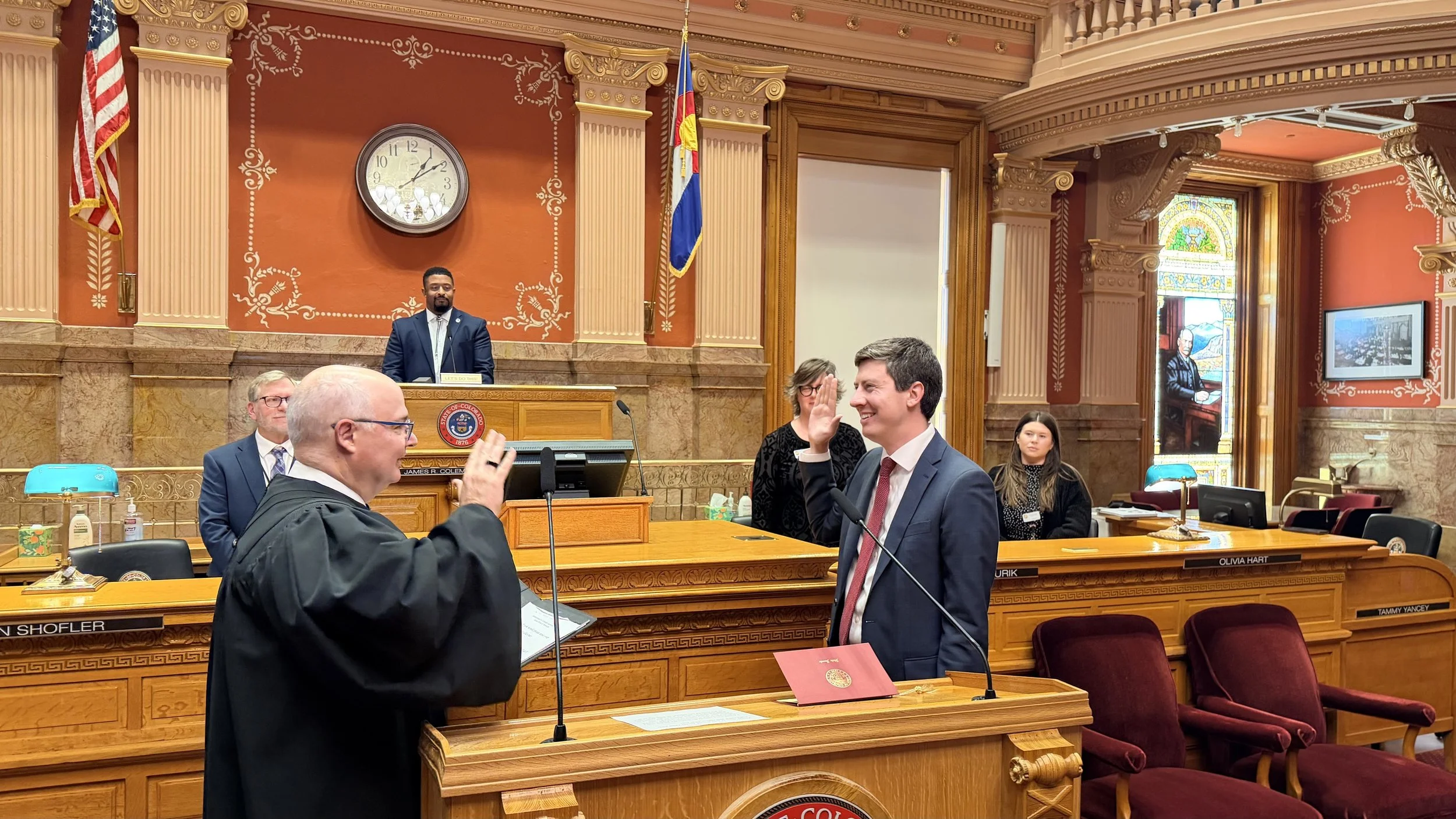
Senator Lindstedt is sworn in by Colorado Supreme Court Justice Brian D. Boatright.
DENVER, CO – Following his official swearing in by Justice Brian D. Boatright, Senate President James Coleman, D-Denver, and Senate Majority Leader Robert Rodriguez, D-Denver, today welcomed Senator William Lindstedt, D-Broomfield, to the Colorado Senate.
“William Lindstedt will be a strong addition to the Colorado State Senate, bringing experience from Broomfield City Council and the Colorado House of Representatives, including as a committee chair,” said Coleman. “We thank Senator Lindstedt for stepping up and we know he will serve with hard work and integrity.”
“We send a heartfelt welcome to William Lindstedt as he joins the Colorado State Senate,” said Rodriguez. “With a proven track record of public service, I am confident that he will be a great partner in achieving our goals of making Colorado more affordable and tackling Colorado’s budget challenges while protecting core services.”
“I’m incredibly grateful to serve as the next State Senator for Senate District 25, representing Broomfield, Northglenn, and Westminster,” said Lindstedt. “This was not how I expected to enter the State Senate, and I know the loss of Senator Winter has been devastating for our community, and for many of us very personally. With the legislative session approaching, I’m ready to get to work immediately to protect Colorado’s clean air and water, boost our public schools, safeguard Medicaid, and stand up to federal overreach.”
Senator William Lindstedt represents Senate District 25, Adams, Broomfield, and Weld Counties. In the House, he was Chair of the House Finance Committee, Chair of the Legislative Audit Committee, and served as a member of the Business & Labor Committee, Transportation, Housing, and Local Government Committees. He has passed dozens of bills to lower the cost of living, fix infrastructure, improve public schools, protect the environment, and make communities safer. Lindstedt is a former assistant bench jeweler, public transit outreach advocate, community organizer, and former member of the Broomfield City Council.
JOINT RELEASE: Right to Repair Electronic Equipment Law Goes Into Effect
DENVER, CO – On January 1, 2026, legislation goes into effect to save consumers money and combat electronic waste. HB24-1121 extends Colorado’s right to repair laws to certain electronic equipment, including cell phones, computers and televisions.
“From pulling up directions to contacting your loved ones, cell phones have become a necessity in our daily lives, and we should have more choices on how to fix them when they break,” said Rep. Brianna Titone, D-Arvada. “This law gives Coloradans the tools they need to fix their broken electronics, saving them money and time on costly repairs. Right to repair laws, like this one, are important for empowering consumers and keeping e-waste out of our landfills. I’m proud to carry this right to repair law to save Coloradans money on everyday electronics like computers, cell phones and household appliances.”
“For generations, whenever one of our tools broke we just went and fixed it,” said Sen. Jeff Bridges, D-Arapahoe County. “Today, most manufacturers make that deliberately impossible to do. The legislation we passed bans practices like parts pairing and software restrictions that lock in customers. This is the first right to repair bill that Google, Apple, and independent repair shops all agreed on. The language we developed here in the Senate has even served as a model in other states and other countries. It's good for consumers, small businesses, and our economy.”
“Consumers should have the right to fix their stuff—computers and cell phones included,” said Rep. Steven Woodrow, D-Denver. “With this law going into effect, consumers will be able to access the tools and tech they need. Added bonus: it saves Coloradans money while reducing waste and pollution.”
“Restrictions on consumers’ ability to fix their cell phones, computers, and other devices lead to surging costs, monopolistic business practices, and thousands of electronics being needlessly thrown out every day,” said Sen. Nick Hinrichsen, D-Pueblo. “I’ve said it before and I’ll say it again: if you can’t repair something that’s yours, do you really own it? I would argue not. I am proud that this law is going into effect that will empower consumers, reduce waste, and ensure a fair market.”
Beginning January 1, 2026, HB24-1121 will require certain digital electronic equipment manufacturers to comply with existing consumer right to repair laws. Original equipment manufacturers (OEMs) such as Amazon, Apple, Google, and others will need to provide software and physical tools to consumers and independent repair providers upon request so they can fix their broken electronics.
Under this law, OEMs can charge a fee for physical tools, but software tools must be made available free of charge for the consumer. This law will save electronics consumers money on necessary equipment repairs while speeding up the repair process. HB24-1121 also prohibits parts pairing, a technology used by manufacturers to program certain parts together, which restricts the consumer's ability to independently repair their devices and allows OEMs to monopolize replacement parts.
In 2023, Rep. Titone and Sen. Hinrichsen championed a first-in-the-nation law for the right to repair agricultural equipment. This law saves farmers and ranchers money and time on costly agricultural equipment repairs. In 2022, Representatives Titone and Ortiz passed two trailblazing right to repair laws specifically for wheelchair users. These laws require wheelchair manufacturers to provide parts and software to consumers and eliminate the need for prior authorization to repair powered wheelchairs and other complex mobility devices for Medicaid recipients. These laws provided the framework for HB24-1121.