

Newsroom
Looking for something specific? Search through our press releases by keyword:
Find Releases by Date
- December 2025
- November 2025
- October 2025
- September 2025
- August 2025
- July 2025
- June 2025
- May 2025
- April 2025
- March 2025
- February 2025
- January 2025
- December 2024
- November 2024
- October 2024
- September 2024
- August 2024
- July 2024
- June 2024
- May 2024
- April 2024
- March 2024
- February 2024
- January 2024
- December 2023
- November 2023
- October 2023
- September 2023
- August 2023
- July 2023
- June 2023
- May 2023
- April 2023
- March 2023
- February 2023
- January 2023
- December 2022
- November 2022
- October 2022
- September 2022
- August 2022
- July 2022
- June 2022
- May 2022
- April 2022
- March 2022
- February 2022
- January 2022
- December 2021
- October 2021
- September 2021
- August 2021
- July 2021
- June 2021
- May 2021
- April 2021
- March 2021
- February 2021
- January 2021
- December 2020
- November 2020
- September 2020
- July 2020
- June 2020
- May 2020
- April 2020
- March 2020
- February 2020
- January 2020
- December 2019
- November 2019
- October 2019
- September 2019
- July 2019
- June 2019
- May 2019
- April 2019
- March 2019
- February 2019
- January 2019
- December 2018
- November 2018
- October 2018
- September 2018
- August 2018
- January 2018
- November 2017
- August 2017
Legislation to Bolster Tax Credits, Better Support Colorado Families Clears Committee
Legislation sponsored by Senators Chris Hansen, D-Denver, and Chris Kolker, D-Centennial, that would bolster critical credits for working families cleared the Senate Finance Committee today.
HB23-1112 would increase the Earned Income and Child Tax Credits by nearly $75 million
DENVER, CO – Legislation sponsored by Senators Chris Hansen, D-Denver, and Chris Kolker, D-Centennial, that would bolster critical credits for working families cleared the Senate Finance Committee today.
HB23-1112 would expand the state Earned Income Tax Credit (EITC) and the Child Tax Credit (CTC), returning nearly $75 million to hardworking families.
“Colorado’s working families deserve a break,” Hansen said. “These critical tax credits will put more money in their pockets, and make it easier to pay for necessities like groceries and rent. I’m proud to champion this legislation that will lift folks out of poverty and will make life easier for Colorado families.”
“Boosting tax credits for hardworking Colorado families just makes sense,” Kolker said. “This bill eases the burden people across our state face, and will help them build better futures for themselves and their families.”
For the 2024 tax year, the Colorado EITC would increase from 25 percent to 40 percent of the federal EITC. A refundable tax credit available to certain families with children under the age of 6, the Colorado CTC would increase by 10 percent in the 2024 tax year, with the tax credit ranging from 20 to 70 percent of the federal CTC depending on marital status, number of qualifying children, and federal adjusted gross income.
The federal Child Tax Credit has lifted over 57,000 Colorado kids out of poverty and helped over 630,000 families across the state, while the federal Earned Income Tax Credit has helped cut the national poverty rate in half.
HB23-1112 will now move to consideration before the Senate Appropriations Committee. Track the bill’s progress HERE.
Senate Approves Landmark Plan to Provide Urgent Property Tax Relief
The Senate today approved landmark legislation that would provide historic property tax relief for homeowners and businesses while ensuring funding for schools and other local governments is protected.
SB23-303 will save taxpayers more than $1 billion on their property taxes
DENVER, CO – The Senate today approved landmark legislation that would provide historic property tax relief for homeowners and businesses while ensuring funding for schools and other local governments is protected.
SB23-303, sponsored by Senate President Steve Fenberg, D-Boulder, and Senator Chris Hansen, D-Denver, creates a long-term solution to prevent growing home values from raising property taxes, and creates limits that protect homeowners and businesses from steep unexpected increases in their property taxes.
"Coloradans are about to get hit with painful property tax spikes, which is why we're taking action now to meet the moment and provide real relief for Colorado families," Fenberg said. "This transformative proposal delivers long-term reductions in property tax rates while providing immediate savings on this year’s property taxes, so we can better support our schools and our communities and build a Colorado everyone can afford to love."
“The cost of housing in Colorado is incredibly high, and if we don't act, Coloradans will suffer record increases on their property taxes. This would be especially difficult for working families, and would hit folks on fixed incomes incredibly hard," said Hansen. "That's why we’re working to provide immediate property tax relief that will save families across our state millions of dollars and keep people in their homes. This proposal will also give voters an opportunity to protect sustainable funding for our schools and local services like hospitals and firefighters while addressing the urgent property tax situation. I'm proud to champion this legislation that will provide immediate relief and protect the critical services Coloradans depend on to thrive."
Coloradans will vote on this package in November, and if approved the proposal will provide major long-term reductions to property tax rates while delivering immediate savings on property taxes this year. Combined with property tax reductions the legislature previously enacted via SB22-238, this proposal will cut the average homeowner’s tax increase in half, saving $1,264 on average over the next two years. In total, this package would provide between $900 million and $1.6 billion annually in property tax relief for homeowners and businesses in Colorado.
Other property tax relief and protections proposed in this plan include:
Reducing the residential assessment rate from 7.15 percent to 6.7 percent in 2023 and 2024, and continuing this reduction for primary residences.
Incrementally reducing the business property assessment rate from 29 percent to at least 26.9 percent by 2032.
Reducing the taxable value of residences by $40,000 in 2023 and 2024, and continuing this reduction for primary residences (not second homes or investment properties) in future years.
Capping the growth in district property tax collections excluding school districts at inflation and allowing local governments to override the cap after giving notice to property owners.
Protecting funding for public education and backfilling revenue to fire districts, water districts, ambulance, and hospital districts in areas of the state that aren’t growing as fast by dedicating a portion of the state TABOR surplus to backfill.
Providing seniors who currently receive the Homestead Exemption a larger reduction of $140,000 and allowing them to continue to receive this reduction if they move.
SB23-303 will now move to the House for further consideration. Track the bill’s progress HERE.
Senate Approves Bill To Save Coloradans Money on Hospital Costs
Today the Senate approved Senators Lisa Cutter, D-Jefferson County, and Kyle Mullica’s, D-Thornton, bill to prohibit certain facility fees.
HB23-1215 would prohibit hospitals from charging certain hidden facility fees
DENVER, CO – Today the Senate approved Senators Lisa Cutter, D-Jefferson County, and Kyle Mullica’s, D-Thornton, bill to prohibit certain facility fees.
HB23-1215 would prohibit certain health care providers from charging hidden facility fees on top of the operating costs for health care services they are already being charged to cover. Providers would also be required to disclose information about facility fees to consumers and post this information in their facilities. The bill would make it a deceptive trade practice to not share facility fee information to patients.
“Medical debt is already a leading cause of bankruptcy in the United States; it is not acceptable that Coloradans are being burdened with unnecessary costs they should not be responsible for,” said Cutter. “Facility fees can range from hundreds to thousands of dollars and are impossible for families to plan for, since they are often unexpected. Further examining and addressing facility fees, and requiring additional transparency, will help save Coloradans money and allow them to better plan and budget for necessary medical care."
“Most Coloradans are unable to afford hundreds or thousands of dollars of surprise hidden fees,” Mullica said. “Surprise fees make it difficult for Coloradans to budget for health care services, deterring people from seeking the care they need altogether. Prohibiting certain facility fees will help protect patients and provide much needed relief for Colorado families.”
HB23-1215 would require the Department of Health Care Policy and Financing (HCPF) to produce a report by December 1, 2023 that outlines the impacts of facility fees to better understand what these fees cover and how these fees impact patient cost and patient health. HCPF would also be required to produce an annual report to improve data collection on facility fees and to increase transparency on the effects of these added costs.
HB23-1215 now returns to the House for consideration of amendments. You can follow the bill’s progress HERE.
Gonzales Bill to Prohibit Most Growth Caps Clears Senate
Senator Julie Gonzales’, D-Denver, bill to prohibit local governments from enacting and enforcing growth caps in order to build more housing faster cleared the Senate today.
HB23-1255 would prohibit most growth caps to build more housing faster
DENVER, CO – Senator Julie Gonzales’, D-Denver, bill to prohibit local governments from enacting and enforcing growth caps in order to build more housing faster cleared the Senate today.
HB23-1255 would prevent local governments from enacting and enforcing housing growth restrictions that limit housing development to a certain number of building permits or approvals without a transparent process and fair consideration of a proposal’s merits. Under the bill, local governments would not be required to approve specific developments or projects, but they would not be able to reject a proposal simply due to an arbitrary growth cap.
"Colorado needs more housing," Gonzales said. "Eliminating arbitrary growth caps will increase supply and allow more Coloradans to remain in the communities they currently live and work in. I’m proud to champion policy that will help communities keep up with ongoing growth, ease displacement, and help us meet our housing needs."
The bill includes exceptions in cases of a declared disaster emergency, for developing or amending residential land use laws, or to acquire or expand public infrastructure like wastewater treatment.
HB23-1255 now returns to the House for consideration of amendments. You can follow the bill’s progress HERE.
Roberts Bill to Create Property Insurance of Last Resort Clears Senate
Legislation sponsored by Senator Dylan Roberts, D-Avon, that would create a program to offer property insurance of last resort to Colorado homeowners in wildfire prone areas cleared the Senate today.
Roberts: “The FAIR Insurance Plan will help protect vulnerable Coloradans and allow folks to insure their homes, businesses, and property against potential disasters."
DENVER, CO – Legislation sponsored by Senator Dylan Roberts, D-Avon, that would create a program to offer property insurance of last resort to Colorado homeowners in wildfire prone areas cleared the Senate today.
HB23-1288 would create the Fair Access to Insurance Requirements (FAIR) Plan Association, a nonprofit, unincorporated legal entity to ensure Coloradans with homes and commercial properties located in wildfire zones can receive homeowners or commercial insurance.
“Wildfires are becoming increasingly destructive, and it’s making it difficult or sometimes impossible for folks who live in rural communities like mine to purchase homeowners insurance,” Roberts said. “The FAIR Insurance Plan will help protect vulnerable Coloradans and allow folks to insure their homes, businesses, and property against potential disasters.”
The program will be operated at no cost to the state — income and losses will be shared proportionally among insurance companies operating in Colorado. FAIR plans will not be issued directly through the state, but rather through participating insurance companies. Insurance under the FAIR plan would be required to include rates that:
Are not excessive, inadequate, or unfairly discriminatory;
Are actuarially sound so that revenue generated from premiums is adequate to pay for expected losses, expenses, and taxes and the cost of reinsurance;
Reflect the investment income of the FAIR plan; and
Reflect the cost of reinsurance or to other capital risk transfer markets.
HB23-1288 will now move to the Governor’s desk. Track the bill’s progress HERE.
Senate Approves Roberts’ Bill to Increase Local Oversight over Short Term Rentals
Senator Dylan Roberts’, D-Avon, bipartisan bill to enhance existing procedures and increase transparency for short term rental regulations cleared the Senate today.
HB23-1287 would increase local oversight over Airbnb and other online listings of short term rentals, clarify procedures for compliance
DENVER, CO – Senator Dylan Roberts’, D-Avon, bipartisan bill to enhance existing procedures and increase transparency for short term rental regulations cleared the Senate today.
Cosponsored by Senator Perry Will, R-New Castle, and Speaker Julie McCluskie, D-Dillon, HB23-1287 gives counties the legal backing to require a property owner or agent to include a rental license or permit in any online listing for a short term property. Additionally, the bill would allow counties to require that online platforms like Airbnb and VRBO remove listings if the owner of a unit has had their license or permit suspended, revoked, or if local rules do not permit the property to be listed as a short term rental.
“Short term rentals are an important part of our tourism economies but local residents also deserve protection from their unintended consequences,” said Roberts. “This bill enhances counties’ authority to enforce existing licensing rules, so that local governments can protect communities from bad actors in the short term rental market.”
County governments are currently authorized to regulate short term rental units; HB23-1287 would clarify the definition of a short term rental and outline county authority to assure compliance on digital platforms. Currently, over 40 percent of homes in Summit County are used as either short term rentals or secondary residences, and resort communities across the state have seen a surge in short term rental conversion since the onset of the pandemic.
HB23-1287 will now move to the Governor's desk. You can follow the bill’s progress HERE.
SIGNED! Legislation to Protect Native American Children and Graduates
Today, Governor Jared Polis signed into law two pieces of legislation to ensure protections for Native American children and students at graduation ceremonies.
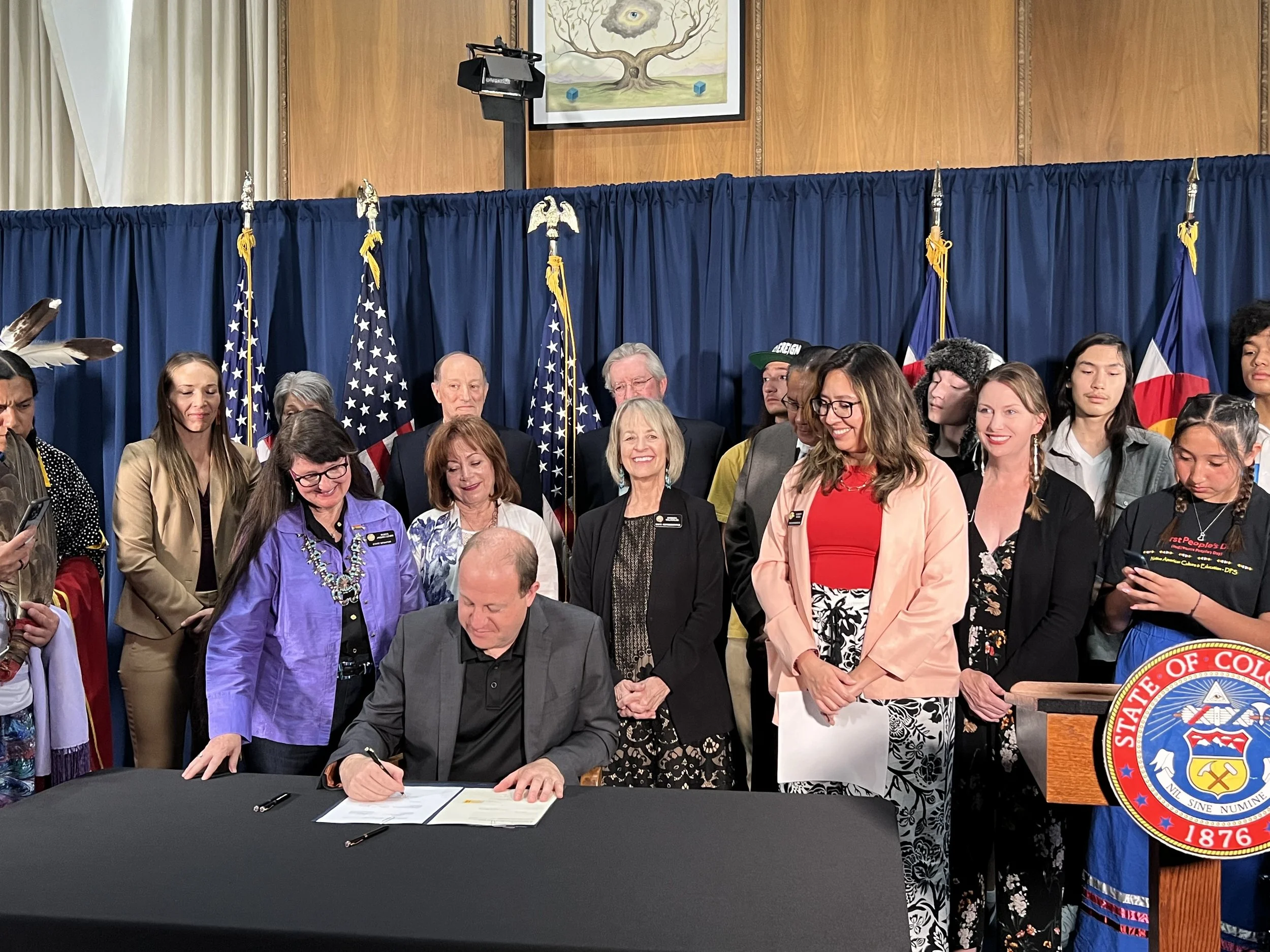
DENVER, CO – Today, Governor Jared Polis signed into law two pieces of legislation to ensure protections for Native American children and students at graduation ceremonies. The Governor and legislators were joined by members and leaders of Colorado’s federally recognized tribes at the signing ceremony, including Southern Ute Indian Tribe Chairman Melvin Baker and the Executive Director of the Colorado Commission of Indian Affairs, Kathryn Redhorse.
SB23-202, sponsored by Senators Jessie Danielson, D-Wheat Ridge, and Sonya Jaquez Lewis, D-Longmont, allows Native American students to wear traditional regalia at graduation ceremonies.
The bill requires schools, school districts and public colleges and universities to allow qualifying students, including those who are members of a Tribe, eligible to be members of a Tribe, or are of Native American descent, to wear traditional Native American regalia at graduation ceremonies. The bill aims to protect Indigenous students from discrimination and reverse the systemic effects of the Indian Civilization Act of 1819.
“Today’s bills signal our commitment to reversing the egregious, systemic effects of removal and assimilation practices, and further fortify tribal rights,” said Danielson. “From schools prohibiting kids to wear celebratory cultural regalia to the Supreme Court overturning decades of legally rock-solid precedent, the need for these bills is clear. With these new laws, the State of Colorado is supporting Native American tribes, families, and kids in the way they deserve.”
“No Native American student should have to choose between participating in their graduation with their classmates or following their religious and cultural traditions,” said Jaquez Lewis. “Our country has a long and tragic history of suppressing Native American culture and forcing people to assimilate. I’m pleased to stand alongside Tribal leaders and members as we enshrine these protections for Native American students once and for all.”
The second bill, SB23-211, sponsored by Danielson and Majority Leader Dominick Moreno, D-Commerce City, secures protections for Native American children in cases of adoption and guardianship. The bill adopts the federal Indian Child Welfare Act of 1978 (ICWA) into state law to ensure that Native American children continue to be protected if the law is struck down fully or partially at the federal level.
ICWA was enacted to safeguard the best interests of Native American children and keep them connected to their families and tribes in cases of separation. The law delineates the roles of state and tribal governments in child welfare cases, but is currently being challenged in the Supreme Court.
“For decades, the Indian Child Welfare Act has been recognized as the gold standard in child welfare practice by experts,” said Moreno. “Now that anti-tribal interests who want to undermine tribal sovereignty have made their way to the Supreme Court, it’s vital that we act immediately to protect Indigenous kids on a state level. This new law puts the best interests of Native American children first, and promotes the stability and security of tribes and families.”
In the 1970’s, studies revealed that 25 to 35 percent of all Native American children were being separated from their parents, extended families, and communities by state child welfare and private adoption agencies. Of those separated, 85 percent were placed outside of their families and communities into non-Native American households – even when fit and willing relatives were available. Since ICWA’s enactment, the law has been successful in keeping Native American children in their families and communities, and ensuring the children’s rights are protected.
Colorado is home to two federally recognized Tribes; the Southern Ute Indian Tribe and the Ute Mountain Ute Tribe. According to the 2020 US Census, 74,129 Native Americans live in Colorado, a higher population than the neighboring states of Utah and Idaho.
SIGNED! Marchman and Jaquez Lewis’ Bill to Expand Access to Mental Health Professionals in Schools Becomes Law
Senators Janice Marchman, D-Loveland, and Sonya Jaquez Lewis’, D-Longmont, bill to increase mental health professionals in schools was signed into law by the Governor today.
SB23-004 aids the youth mental health crisis by allowing licensed mental health professionals to work in schools

DENVER, CO – Senators Janice Marchman, D-Loveland, and Sonya Jaquez Lewis’, D-Longmont, bill to increase mental health professionals in schools was signed into law by the Governor today.
Previously, a mental health professional had to be licensed by the Department of Education in order to work in a school – a process that was time-consuming and complex. SB23-004 allows school districts to employ mental health professionals who hold a Colorado license but don’t have a license from the Department of Education, streamlining the hiring process and expanding access to mental health resources in schools.
“Schools are an essential part of supporting the health and well-being of our students,” said Marchman. “By allowing qualified school-based therapists to work alongside our mental health special service providers in schools, we can improve access to mental health resources and ensure that students in crisis can get the help they need.”
“The youth mental health crisis was prevalent before the pandemic, and has only grown in recent years,” Jaquez Lewis said. “In order to best help our students, we need to expand access to mental health professionals in schools. This law will make it easier for kids to seek care in a place they feel comfortable and safe.”
In 2021, Children’s Hospital Colorado declared a youth mental health emergency, and the following year stated that conditions had worsened. Furthermore, in 2022, the Centers for Disease Control and Prevention released a survey showing that 44 percent of high school students reported feeling persistently sad or hopeless during the past year.
SIGNED! Fields & Exum’s Bill to Reduce Costs for Renters
HB23-1099 will implement portable screening reports, lowering application costs for prospective tenants

DENVER, CO – Today, Senators Rhonda Fields, D-Aurora, and Tony Exum’s, D-Colorado Springs, bill to require landlords to accept recent screening reports from applicants without charging an application fee was signed into law.
If a prospective tenant doesn’t provide a screening report, landlords may charge an application fee, but HB23-1099 requires that they provide applicants with a free copy that they can present to any other prospective landlord within 30 days of the report publication.
“Too many Coloradans searching for a rental have found themselves spending hundreds of dollars in unnecessary fees for something they’ve previously paid for,” said Fields. “Applying to rent a home shouldn’t require redundant, substantial fees and a negative impact on one’s credit. We have to continue to fight rising housing expenses across the board, including application costs, so that every Colorado family can find a place to call home without breaking the bank.”
“Our state is in a housing crisis, which is why we’ve been fighting to reduce the many barriers to housing that exist in our state,” said Exum. “Paying for a new screening report every time someone applies for a lease is a big financial burden, especially if it’s their fourth, fifth, or sixth application. This new law allows for greater transparency between landlords and prospective tenants while reducing the cost of finding a new place to live.”
Additionally, HB23-1099 allows prospective tenants whose application was denied based on their screening report to dispute the accuracy of the report, and the bill exempts landlords who refund an application fee within 20 days of rejecting a prospective tenant.
Senate Advances Landmark Plan to Provide Urgent Property Tax Relief
The Senate today advanced landmark legislation on second reading that would provide historic property tax relief for homeowners and businesses while ensuring funding for schools and other local governments is protected.
SB23-303 will save taxpayers more than $1 billion on their property taxes
DENVER, CO – The Senate today advanced landmark legislation on second reading that would provide historic property tax relief for homeowners and businesses while ensuring funding for schools and other local governments is protected.
SB23-303, sponsored by Senate President Steve Fenberg, D-Boulder, and Senator Chris Hansen, D-Denver, creates a long-term solution to prevent growing home values from raising property taxes, and creates limits that protect homeowners and businesses from steep unexpected increases in their property taxes.
"Coloradans are about to get hit with painful property tax spikes, which is why we're taking action now to meet the moment and provide real relief for Colorado families," Fenberg said. "This transformative proposal delivers long-term reductions in property tax rates while providing immediate savings on this year’s property taxes, so we can better support our schools and our communities and build a Colorado everyone can afford to love."
“The cost of housing in Colorado is incredibly high, and if we don't act, Coloradans will suffer record increases on their property taxes. This would be especially difficult for working families, and would hit folks on fixed incomes incredibly hard," said Hansen. "That's why we’re working to provide immediate property tax relief that will save families across our state millions of dollars and keep people in their homes. This proposal will also give voters an opportunity to protect sustainable funding for our schools and local services like hospitals and firefighters while addressing the urgent property tax situation. I'm proud to champion this legislation that will provide immediate relief and protect the critical services Coloradans depend on to thrive."
Coloradans will vote on this package in November, and if approved the proposal will provide major long-term reductions to property tax rates while delivering immediate savings on property taxes this year. Combined with property tax reductions the legislature previously enacted via SB22-238, this proposal will cut the average homeowner’s tax increase in half, saving $1,264 on average over the next two years. In total, this package would provide between $900 million and $1.6 billion annually in property tax relief for homeowners and businesses in Colorado.
Other property tax relief and protections proposed in this plan include:
Reducing the residential assessment rate from 7.15 percent to 6.7 percent in 2023 and 2024, and continuing this reduction for primary residences.
Incrementally reducing the business property assessment rate from 29 percent to at least 26.9 percent by 2032.
Reducing the taxable value of residences by $40,000 in 2023 and 2024, and continuing this reduction for primary residences (not second homes or investment properties) in future years.
Capping the growth in district property tax collections excluding school districts at inflation and allowing local governments to override the cap after giving notice to property owners.
Protecting funding for public education and backfilling revenue to fire districts, water districts, ambulance and hospital districts in areas of the state that aren’t growing as fast by dedicating a portion of the state TABOR surplus to backfill.
Providing seniors who currently receive the Homestead Exemption a larger reduction of $140,000 and allowing them to continue to receive this reduction if they move.
SB23-303 will now be heard in the Senate on third reading before moving to the House for further consideration. Track the bill’s progress HERE.
Senate Passes Pair of Bills To Invest in Clean Energy
Today the Senate passed a pair of bills to invest in clean energy technologies.
Legislation would provide increased opportunities to adopt carbon management technologies and thermal energy as a clean heat resource
DENVER, CO – Today the Senate passed a pair of bills to invest in clean energy technologies.
HB23-1210, sponsored by Senator Chris Hansen, D-Denver, would direct the Colorado Energy Office (CEO) to develop a carbon management roadmap and help Colorado companies successfully undertake carbon management projects such as carbon removal, storage, and utilization. It creates a new funding avenue for these projects by expanding the eligibility criteria of CEO’s Industrial and Manufacturing Operations Clean Air Grants Program.
“Achieving Colorado’s bold climate goals requires innovation,” Hansen said. “Carbon removal is emerging as an innovative, successful technology to be used in the pursuit of a net-zero economy. I’m proud to help Colorado become a leader in carbon management and I look forward to all we’re able to accomplish when this legislation is passed.”
The Senate also passed Senator Tony Exum Sr.’s, D-Colorado Springs, bill to continue Colorado’s work to reduce emissions from gas utilities by providing a pathway for wider adoption of thermal energy as a clean heat resource. HB23-1252 aims to assist in the transition away from expensive fuel commodities like natural gas and lower utility costs for Coloradans.
“Adopting new clean energy technologies like thermal energy will help create jobs while lowering overall emissions,” said Exum. “Natural gas is driving up utility costs and putting the squeeze on Coloradans' budgets. We have an opportunity this year to continue moving away from polluting energy sources and instead adopt cleaner technology to move Colorado’s economy and climate goals forward.”
Thermal energy systems heat and cool buildings by circulating non-combustible fluids through a pipe network. Defining thermal energy as a clean heat resource allows the state to expand its usage, which will create new job opportunities, decrease greenhouse gas emissions and save Coloradans money on their utility bills.
HB23-1210 will head back to the House for concurrence of amendments, while HB23-1252 heads to the Governor’s desk. Follow their progress HERE and HERE, respectively.
Gonzales & Rodriguez Bill To Make Prison Phone Calls Free Passes Senate
Senators Julie Gonzales, D-Denver, and Robert Rodriguez’s, D-Denver, bill to make prison phone calls free and keep families connected passed the Senate today.
HB23-1133 would help incarcerated people stay connected to family and friends without incurring undue financial burden
DENVER, CO – Senators Julie Gonzales, D-Denver, and Robert Rodriguez’s, D-Denver, bill to make prison phone calls free and keep families connected passed the Senate today.
Over several years, HB23-1133 would phase in cost reductions to phone calls made to and from incarcerated people in Department of Corrections (DOC) facilities until they are completely free. The bill requires the DOC to cover 25 percent of the cost of phone calls in their facilities starting on September 1, 2023; 35 percent of the cost starting on July 1, 2024; and to cover the full cost of phone calls starting July 1, 2025.
“Maintaining meaningful connections with friends and family helps incarcerated people envision a full life outside of the carceral system,” Gonzales said. “Eliminating the costs of prison phone calls for incarcerated people and their loved ones will help restore hope for those in our corrections system. I am proud to champion this legislation, a low cost effort to reduce the likelihood of recidivism and help people maintain dignity while incarcerated.”
“No cost prison phone calls will help incarcerated Coloradans stay connected to resources that can help them succeed outside of prison,” said Rodriguez. “Data shows that people who are able to maintain connections with their support system are more likely to succeed and less likely to return to the prison system. Making prison phone calls free is the right thing to do for incarcerated Coloradans and their families and friends.”
The DOC currently charges eight cents per minute for phone calls, adding up to an annual cost of $438 for an incarcerated individual who makes a daily 15 minute phone call. If HB23-1133 is enacted, Colorado would join California and Connecticut as the third state to cover the cost of all state prison phone calls.
Finally, the bill would require the Division of Youth Services (DYS) in the Department of Human Services to provide free phone calls for youth detained in a juvenile detention facility and dictates that DYS may not receive any revenue, including commissions or fees.
HB23-1133 now heads to the Governor’s desk for signature. You can follow the bill’s progress HERE.
Senate Approves Bill to Strengthen Support for Survivors of Domestic Violence
The Senate passed legislation to strengthen victim protections in domestic violence cases with bipartisan support.
DENVER, CO – The Senate passed legislation to strengthen victim protections in domestic violence cases with bipartisan support.
HB23-1222, sponsored by Senators Faith Winter, D-Westminster, and Dylan Roberts, D-Avon, would require municipalities that criminalize domestic violence to establish protections and rights for victims consistent with the Victims Rights Act (VRA). These requirements include that:
Victims, victims’ families, and witnesses of a domestic violence violation will receive protections and rights under the VRA;
Sentencing, probation, and release on bond for a violation must be consistent with state law;
Guidelines and standards are consistent with those adopted by the Domestic Violence Offender Management Board; and
The prosecuting attorney that originally meets with the victim should make an effort to stay on the case throughout the proceeding.
“I’m proud to be a part of multiple pieces of transformative legislation to strengthen autonomy and control for survivors of intimate violence,” said Winter. “No survivor should ever have to pay a bill for their forensic exam, or feel unsafe during their court proceedings. This bill signals our commitment to furthering support for survivors of domestic violence in Colorado.”
“Since the pandemic, domestic violence cases have surged across the United States, including here in Colorado,” Roberts said. “Under current law, county and municipal courts aren’t held to the same procedural standards for domestic violence cases, which allows perpetrators and survivors to fall through the cracks. This bill will improve the way municipal courts handle domestic violence cases – ensuring survivors are given the protections they deserve while creating a safer state for all Coloradans.”
The Colorado Domestic Violence Fatality Review Board reported that there were 91 fatalities due to domestic violence in 2021 – the highest the state has seen since the board was founded in 2017.
HB23-1222 now heads to the Governor’s desk. Follow its progress HERE.
Gonzales Bill to Prohibit Most Growth Caps Clears Committee
Senator Julie Gonzales’, D-Denver, bill to prohibit local governments from enacting and enforcing growth caps in order to build more housing faster cleared the Senate Local Government and Housing Committee today.
HB23-1255 would prohibit most growth caps to build more housing faster
DENVER, CO – Senator Julie Gonzales’, D-Denver, bill to prohibit local governments from enacting and enforcing growth caps in order to build more housing faster cleared the Senate Local Government and Housing Committee today.
HB23-1255 would prevent local governments from enacting and enforcing housing growth restrictions that limit housing development to a certain number of building permits or approvals without a transparent process and fair consideration of a proposal’s merits. Under the bill, local governments would not be required to approve specific developments or projects, but they would not be able to reject a proposal simply due to an arbitrary growth cap.
"Colorado needs more housing," Gonzales said. "Eliminating arbitrary growth caps will increase supply and allow more Coloradans to remain in the communities they currently live and work in. I’m proud to champion policy that will help communities keep up with ongoing growth, ease displacement, and help us meet our housing needs."
The bill includes exceptions in cases of a declared disaster emergency, for developing or amending residential land use laws, or to acquire or expand public infrastructure like wastewater treatment.
HB23-1255 now heads to the Senate floor for further consideration. You can follow the bill’s progress HERE.
Roberts’ Bill to Increase Local Oversight over Short Term Rentals Clears Committee
Senator Dylan Roberts’, D-Avon, bipartisan bill to enhance existing procedures and increase transparency for short term rental regulations cleared the Senate Local Government and Housing committee today.
HB23-1287 would increase local oversight over Airbnb and other online listings of short term rentals, clarify procedures for compliance
DENVER, CO – Senator Dylan Roberts’, D-Avon, bipartisan bill to enhance existing procedures and increase transparency for short term rental regulations cleared the Senate Local Government and Housing committee today.
HB23-1287 gives counties the legal backing to require a property owner or agent to include a rental license or permit in any online listing for a short term property. Additionally, the bill would allow counties to require that online platforms like Airbnb and VRBO remove listings if the owner of a unit has had their license or permit suspended, revoked, or if local rules do not permit the property to be listed as a short term rental.
“Short term rentals are an important part of our tourism economies but local residents also deserve protection from their unintended consequences,” said Roberts. “This bill enhances counties’ authority to enforce existing licensing rules, so that local governments can protect communities from bad actors in the short term rental market.”
County governments are currently authorized to regulate short term rental units; HB23-1287 would clarify the definition of a short term rental and outline county authority to assure compliance on digital platforms. Currently, over 40 percent of homes in Summit County are used as either short term rentals or secondary residences, and resort communities across the state have seen a surge in short term rental conversion since the onset of the pandemic.
HB23-1287 is cosponsored by Sen. Perry Will, R-New Castle, and Speaker Julie McCluskie, D-Dillon, and will now move to the Senate floor for consideration. You can follow the bill’s progress HERE.
Finance Committee Approves Bill To Support Universal Preschool Program
Senate Majority Leader Dominick Moreno, D-Commerce City, and Senator Rhonda Fields’, D-Aurora, bill to support and maintain Colorado’s Universal Preschool Program (UPK) cleared the Senate Finance Committee today.
Legislation would refer a measure to the November 2023 ballot to retain excess revenue collected from Proposition EE
DENVER, CO – Senate Majority Leader Dominick Moreno, D-Commerce City, and Senator Rhonda Fields’, D-Aurora, bill to support and maintain Colorado’s Universal Preschool Program (UPK) cleared the Senate Finance Committee today.
HB23-1290 would refer a measure to the November 2023 ballot asking voters to allow the state to keep the excess revenue collected on tobacco and other tobacco products to fund UPK in Colorado. If approved by voters, the measure would allow the state to direct the nearly $24 million in excess revenue to support Colorado’s early childhood learners, instead of refunding that amount to the tobacco industry.
"Preschool programs play a vital role in Colorado's communities by laying a strong foundation for children and providing essential child care services for working parents," Moreno said. "This bill presents an opportunity for voters to redirect much-needed funds towards Colorado's early education system, instead of returning them to tobacco distributors and wholesalers. With the potential to infuse nearly $24 million into preschool programs, HB23-1290 represents a wise investment in the future of our children and our state."
“In 2020, voters overwhelmingly supported taxing tobacco and nicotine products to fund Colorado’s transformational Universal Preschool Program and boost learning opportunities for our youngest Coloradans,” said Fields. “This bill gives voters the chance to build on that progress and utilize existing funding to support even more families seeking preschool programs.”
In 2020 Colorado voters approved Proposition EE, which created new excise taxes on cigarettes, tobacco and nicotine products to fund a number of priorities, including UPK. The new tax rates are designed to phase in over the next few fiscal years through 2027. When originally approved by voters, it was estimated that this measure would raise $186.5 million in new tax revenue in its first year. Actual revenues from the new tobacco taxes exceeded that predicted amount by nearly $24 million.
HB23-1290 now heads to the Senate floor for further consideration. You can follow the bill’s progress HERE.
Senate Judiciary Committee Advances Pair of Bills to Strengthen Support for Survivors of Sexual Assault, Domestic Violence
The Senate Judiciary Committee unanimously passed legislation to strengthen victim protections in domestic violence cases and improve sexual assault survivors’ access to information.
DENVER, CO – The Senate Judiciary Committee unanimously passed legislation to strengthen victim protections in domestic violence cases and improve sexual assault survivors’ access to information.
HB23-1222, sponsored by Senators Faith Winter, D-Westminster, and Senator Dylan Roberts, D-Avon, would require municipalities that criminalize domestic violence to establish protections and rights for victims consistent with the Victims Rights Act (VRA). These requirements include that:
Victims, victims’ families, and witnesses of a domestic violence violation will receive protections and rights under the VRA;
Sentencing, probation, and release on bond for a violation must be consistent with state law;
Guidelines and standards are consistent with those adopted by the Domestic Violence Offender Management Board; and
The prosecuting attorney that originally meets with the victim should make an effort to stay on the case throughout the proceeding.
“Since the pandemic, domestic violence cases have surged across the United States, including here in Colorado,” Roberts said. “Under current law, county and municipal courts aren’t held to the same procedural standards for domestic violence cases, which allows perpetrators and survivors to fall through the cracks. This bill will improve the way municipal courts handle domestic violence cases – ensuring survivors are given the protections they deserve while creating a safer state for all Coloradans.”
The Colorado Domestic Violence Fatality Review Board reported that there were 91 fatalities due to domestic violence in 2021 – the highest the state has seen since the board was founded in 2017.
Yesterday the Senate Judiciary Committee passed HB23-1199, also sponsored by Winter. The bill would require the Department of Public Safety to create a statewide system for sexual assault survivors to monitor the status of evidence obtained during their forensic medical examinations.
“I’m proud to be a part of multiple pieces of transformative legislation to strengthen autonomy and control for survivors of intimate violence,” said Winter. “No survivor should ever have to pay a bill for their forensic exam, or feel unsafe during their court proceedings. These bills signal our commitment to furthering support for survivors of sexual assault and domestic violence in Colorado.”
The bipartisan bill aims to bolster the SAVE program, established under HB13-1163, with critical funding to ensure sexual assault survivors aren’t discouraged from getting a rape kit nor billed for a forensic exam.
HB23-1199 now heads to the Senate Appropriations Committee, while HB23-1222 heads to the Senate floor. Their progress can be found HERE and HERE, respectively.
Senate Advances Pair of Bills to Save Money on Prescription Drugs, Improve Hospital Transparency
The Senate today advanced a pair of bills that will save Colorado families money on prescription drugs and improve transparency for hospitals.
DENVER, CO – The Senate today advanced a pair of bills that will save Colorado families money on prescription drugs and improve transparency for hospitals.
HB23-1201, sponsored by Senator Kyle Mullica, D-Thornton, would lower prescription drug costs by cracking down on pharmacy benefit managers (PBMs) who charge employers one price for prescription drugs and reimburse pharmacies for less, and pocket the difference in a practice known as spread pricing.
“Prescription drugs in Colorado are sometimes too expensive for working families to afford, and that’s unacceptable,” Mullica said. “Prohibiting pharmacy benefit managers from skimming profits off the top of prescription drug prices will keep more money in the pockets of hardworking Colorado families and help more folks afford the lifesaving medication they need to survive.”
The Senate also advanced HB23-1218, sponsored by Senator Sonya Jaquez Lewis, D-Longmont, which requires certain health care facilities to share details with the Colorado Department of Public Health and Environment (CDPHE) of the health care services they provide.
The bill requires CDPHE to create forms to compile a list of services that a health care facility may deny for non-medical reasons, like abortion and gender-affirming care.
“Every Coloradan deserves quality care that meets their needs and allows them to thrive,” Jaquez Lewis said. “Shining a light on which health care services Colorado hospitals provide - and which services they deny - will help Coloradans make more informed choices about where they receive their health care.”
The forms will be shared with the public biannually so they have a better understanding of facilities that meet their specific health care needs. Providers must also make their forms available to their patients to disclose the care they offer due to the informed consent process.
HB23-1201 and HB23-1218 will both move back to the House for consideration of amendments. Track HB23-1201’s progress HERE, and HB23-1218’s progress HERE.
Fenberg’s Bill To Expand Clean Energy & Save Coloradans Money Earns Full Senate Approval
Senate President Steve Fenberg’s, D-Boulder, bill to implement tax incentives to reduce the costs of adopting clean energy technologies for Colorado residents and businesses passed the Senate today.
HB23-1272 includes approximately $65 million in annual tax credits and incentives for businesses and consumers for decarbonization investments
DENVER, CO – Senate President Steve Fenberg’s, D-Boulder, bill to implement tax incentives to reduce the costs of adopting clean energy technologies for Colorado residents and businesses passed the Senate today.
HB23-1272 is part of a package of legislation to incentivize the adoption of clean energy technologies and build upon federal initiatives to save Coloradans money, create good-paying jobs, and help the state meet its climate goals.
The bill includes incentives to advance and adopt clean transportation methods, high-efficiency heat pumps, geothermal electricity development, and measures to reduce industrial emissions. Tax incentives in the bill are expected to average around $65 million each year with individual elements ramping up or down over time depending on available technologies and economic conditions.
“Colorado has become a national leader in promoting clean energy technologies, but there’s much more we can do,” said Fenberg. “In order to further our commitment to our climate goals, we must do more to make adopting clean energy technology a feasible and attractive option for Coloradans – no matter their zip code or income level. The tax credits we’re working to pass this year will save Colorado residents and businesses money, help us meet our climate goals, and improve Colorado’s air quality.”
HB23-1272 would:
Extend and expand electric vehicle tax credits and create an additional $2,500 credit for electric vehicles under $35,000.
Continue the innovative truck tax credit for electric and plug-in hybrid electric trucks, with the credit ranging between $5,000 and $12,000 depending on the truck’s weight starting in 2024.
Create an $500 refundable income tax credit for bicycle retailers for the sale of qualifying e-bikes so that retailers can offer immediate price reductions to purchasers.
Design a refundable income tax credit for the installation of heat pump technology in residential and nonresidential buildings. The credits would vary based on the type and use of the heat pump.
Extend incentives for industrial and manufacturing facilities in Colorado to reduce air pollution through various qualifying efficiency, onsite energy generation, carbon capture, electrification, and other eligible measures.
Create the refundable sustainable aviation fuel (SAF) production facility tax credit worth up to $1-3 million annually for the costs of constructing a SAF production facility.
The bill compliments and builds on incentives included in the Federal Inflation Reduction Act and the Infrastructure Investment and Jobs Act and to help residents and businesses maximize their ability to bring federal dollars to Colorado.
HB23-1272 now heads to the House for consideration of Senate amendments. You can follow the bill’s progress HERE.
Gonzales & Rodriguez Bill To Make Prison Phone Calls Free Clears Committee
Senators Julie Gonzales, D-Denver, and Robert Rodriguez’s, D-Denver, bill to make prison phone calls free and keep families connected cleared the Senate Judiciary Committee today.
HB23-1133 would help incarcerated people stay connected to family and friends without incurring undue financial burden
DENVER, CO – Senators Julie Gonzales, D-Denver, and Robert Rodriguez’s, D-Denver, bill to make prison phone calls free and keep families connected cleared the Senate Judiciary Committee today.
Over several years, HB23-1133 would phase in cost reductions to phone calls made to and from incarcerated people in Department of Corrections (DOC) facilities until they are completely free. The bill requires the DOC to cover 25 percent of the cost of phone calls in their facilities starting on September 1, 2023; 35 percent of the cost starting on July 1, 2024; and to cover the full cost of phone calls starting July 1, 2025.
“Maintaining meaningful connections with friends and family helps incarcerated people envision a full life outside of the carceral system,” Gonzales said. “Eliminating the costs of prison phone calls for incarcerated people and their loved ones will help restore hope for those in our corrections system. I am proud to champion this legislation, a low cost effort to reduce the likelihood of recidivism and help people maintain dignity while incarcerated.”
“No cost prison phone calls will help incarcerated Coloradans stay connected to resources that can help them succeed outside of prison,” said Rodriguez. “Data shows that people who are able to maintain connections with their support system are more likely to succeed and less likely to return to the prison system. Making prison phone calls free is the right thing to do for incarcerated Coloradans and their families and friends, and I look forward to seeing this bill across the finish line.”
The DOC currently charges eight cents per minute for phone calls, adding up to an annual cost of $438 for an incarcerated individual who makes a daily 15 minute phone call. If HB23-1133 is enacted, Colorado would join California and Connecticut as the third state to cover the cost of all state prison phone calls.
Finally, the bill would require the Division of Youth Services (DYS) in the Department of Human Services to provide free phone calls for youth detained in a juvenile detention facility and dictates that DYS may not receive any revenue, including commissions or fees.
HB23-1133 now heads to the Appropriation Committee for further consideration. You can follow the bill’s progress HERE.